Business · Book club
The Ideal Team Player book club questions
Here are 11 book club questions for The Ideal Team Player by Patrick Lencioni, ordered to open easily and end somewhere worth arguing about. Copy them, print them, or bring them up one at a time.
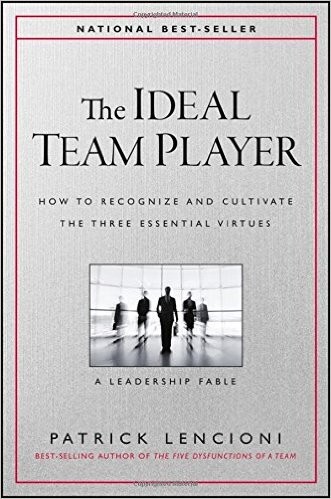
The Ideal Team Player is Patrick Lencioni's business fable about the three qualities that distinguish people who thrive in team environments from those who undermine them.
Patrick Lencioni · 2016 · 4h 0m
Full summary and key takeaways →The 11 questions
- 1.
Think about the best team you've ever been part of. Did its members collectively embody humble, hungry, and smart? Which of the three was most present?
- 2.
Which of the seven combination types from the framework — the ideal, the three single-virtue types, the three two-virtue types — do you most often encounter in your hiring and team dynamics?
- 3.
Who in your current team is a skillful politician — hungry and smart but not humble? What is that costing the team?
- 4.
Where do you fall on the three virtues personally? Be honest. Which one is hardest for you to maintain consistently?
- 5.
What interview questions do you currently use to assess each virtue? Are they effective? What patterns have you seen that predict whether someone will embody each quality?
- 6.
Lencioni says the accidental mess-maker is humble and hungry but not interpersonally smart. Have you managed someone like this? What was the intervention?
- 7.
The lovable slacker is pleasant but not driving the team forward. How do organizations inadvertently create conditions that reward slacker behavior?
- 8.
How does your organization currently create cultural conditions that bring out humility, hunger, and interpersonal intelligence? What's missing?
- 9.
The book argues that these are virtues rather than skills — character qualities rather than learned competencies. Do you agree with that framing? What are the practical implications?
- 10.
If you had to hire for only one of the three virtues and develop the others over time, which would you prioritize and why?
- 11.
What would have to change about your organization's hiring process to screen effectively for all three virtues?
How to run the discussion
- Pick six to eight, not all of them. An hour of real discussion covers fewer questions than anyone expects, and racing the list is what makes a book club feel like homework.
- Open with what people noticed, not what they concluded. Asking for a verdict first hardens opinions before anyone has heard each other.
- Let the disagreement run. The questions below that split a room are the ones worth the time; the ones everyone answers the same way can be skipped.
- Ask the quiet person a specific question. A direct, narrow question is far easier to answer than an open invitation to contribute.
Themes worth steering toward
If the conversation stalls, these are the threads that usually restart it.
Common questions
What are good book club questions for The Ideal Team Player?
Here are 11 book club questions for The Ideal Team Player by Patrick Lencioni, ordered to open easily and end somewhere worth arguing about. The strongest openers ask what each reader noticed rather than what they concluded, and the discussion usually turns on team building, hiring, culture.
How long should a book club discussion of The Ideal Team Player last?
Most groups run 60 to 90 minutes of actual discussion. That is roughly six to eight questions, not all of them, so pick the ones that suit your group rather than working down the list in order.
What are the main themes in The Ideal Team Player?
Team building, Hiring, Culture, Leadership, Character. Those are the threads most likely to divide a room, which makes them the useful places to steer a discussion that has gone quiet.
Picking the next one? See books like The Ideal Team Player or questions for other book club picks.
