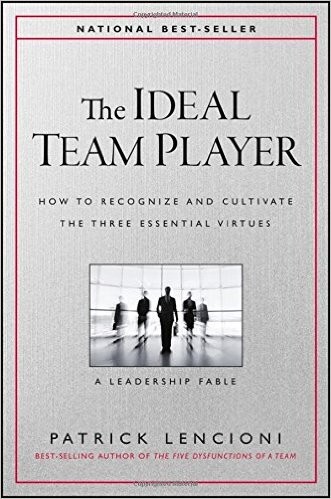
The Ideal Team Player by Patrick Lencioni is a 2016 business book about team building, hiring, culture. The three virtues of the ideal team player are humble (not ego-driven), hungry (self-motivated and driven), and smart (interpersonally aware and effective).
Summary
The Ideal Team Player is Patrick Lencioni's business fable about the three qualities that distinguish people who thrive in team environments from those who undermine them. Written in Lencioni's signature narrative style, the book follows a CEO navigating a family company acquisition and a leadership team that must hire quickly — which forces them to get explicit about what they're actually looking for in people.
The three virtues are humble, hungry, and smart. Humble means ego is not the primary concern — genuinely humble people don't need to protect their status or take credit, which allows real collaboration. Hungry means driven — self-motivated, diligent, and always looking for more to do rather than the minimum required. Smart in this context means interpersonally smart — having good judgment about how to interact with people, reading situations and adjusting accordingly, rather than purely intellectual intelligence.
The power of the framework is in the combinations. Any of the three virtues alone produces a specific type of difficult team member. Humble and hungry without smart is the "accidental mess-maker" — well-intentioned but oblivious, constantly creating interpersonal problems without knowing it. Humble and smart without hungry is the "lovable slacker" — pleasant to have around, limited in what they contribute. Hungry and smart without humble is the "skillful politician" — the most dangerous of the three, advancing their own interests while appearing to serve the team.
The practical focus of the non-narrative sections is on hiring and culture. Lencioni offers specific interview questions for each virtue and describes the cultural conditions that bring these virtues out in existing team members — and suppress them. The book is shorter and more prescriptive than The Advantage or The Five Dysfunctions, making it the easiest entry point into Lencioni's management thinking.
Talk to The Ideal Team Player like its author wrote you back.
Get the ideas that fit your life — not generic summaries.
- Chat with the book
- Audiobook-style main ideas
- Adapts to your life and goals
- Helps you take action
Key takeaways
- 1.
The three virtues of the ideal team player are humble (not ego-driven), hungry (self-motivated and driven), and smart (interpersonally aware and effective).
- 2.
Any single virtue without the other two produces a specific type of problematic team member. The combinations matter as much as the individual qualities.
- 3.
Humble and hungry without smart is the accidental mess-maker — creates interpersonal problems without awareness or intent.
- 4.
Humble and smart without hungry is the lovable slacker — pleasant to have around but not someone who moves the team forward.
- 5.
Hungry and smart without humble is the most dangerous: the skillful politician who advances personal interests while appearing collaborative. They're the hardest to identify and the most corrosive.
- 6.
Hiring for these virtues requires specific behavioral interview questions that go beyond standard competency-based assessments.
- 7.
Existing team members who lack one or more virtues can often be developed, but only if they can be made aware of the gap and genuinely want to close it.
- 8.
Organizations that make these three virtues explicit create cultural pressure toward them — which gradually improves hiring and performance without requiring constant management intervention.
Discussion questions
Use these on your own, with a book club, or as chat starters in Superbook. Book club version, ready to copy or print →
- 1.
Think about the best team you've ever been part of. Did its members collectively embody humble, hungry, and smart? Which of the three was most present?
- 2.
Which of the seven combination types from the framework — the ideal, the three single-virtue types, the three two-virtue types — do you most often encounter in your hiring and team dynamics?
- 3.
Who in your current team is a skillful politician — hungry and smart but not humble? What is that costing the team?
- 4.
Where do you fall on the three virtues personally? Be honest. Which one is hardest for you to maintain consistently?
- 5.
What interview questions do you currently use to assess each virtue? Are they effective? What patterns have you seen that predict whether someone will embody each quality?
- 6.
Lencioni says the accidental mess-maker is humble and hungry but not interpersonally smart. Have you managed someone like this? What was the intervention?
- 7.
The lovable slacker is pleasant but not driving the team forward. How do organizations inadvertently create conditions that reward slacker behavior?
- 8.
How does your organization currently create cultural conditions that bring out humility, hunger, and interpersonal intelligence? What's missing?
- 9.
The book argues that these are virtues rather than skills — character qualities rather than learned competencies. Do you agree with that framing? What are the practical implications?
- 10.
If you had to hire for only one of the three virtues and develop the others over time, which would you prioritize and why?
- 11.
What would have to change about your organization's hiring process to screen effectively for all three virtues?
Themes
Frequently asked questions
-
Is The Ideal Team Player worth reading?
Yes, especially if you're in a hiring or team-building role and want a simple, memorable framework. The three-virtue model is easy to remember and apply, and the business fable format makes the concepts stick better than a straight argument would. It complements The Five Dysfunctions but doesn't require reading that book first.
-
How long does it take to read The Ideal Team Player?
Around three to four hours for the 212-page book. The narrative section reads quickly; the non-fiction summary at the end is brief.
-
What's the difference between humble and simply unconfident?
Humble in Lencioni's sense means not needing to protect or advance your ego — it's compatibility with giving and receiving honest feedback, sharing credit, and acknowledging mistakes. It's not the same as lacking confidence. Confident people can be genuinely humble; insecure people can perform humility while nursing resentment.
-
Who should read The Ideal Team Player?
Leaders doing significant hiring, HR professionals designing interviews and assessments, and anyone trying to build or repair team culture. It's also a useful quick read for leaders who want to diagnose interpersonal team problems with a simple model.
-
What's the most actionable idea in the book?
The specific interview questions Lencioni suggests for each virtue, particularly the questions designed to surface hunger and interpersonal intelligence — the two virtues that candidates most reliably fake in standard interviews. The humble virtue is usually visible from resume and references; hunger and smart are what the questions are designed to reveal.