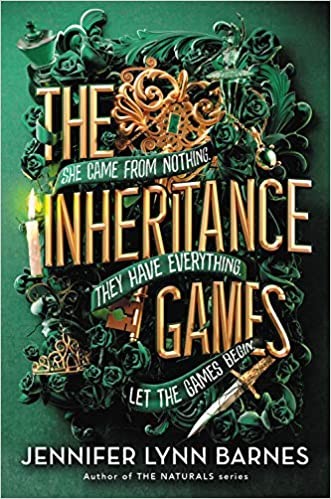
The Inheritance Games by Jennifer Lynn Barnes is a 2020 mystery book about secrets and family legacy, class and wealth, identity. Inherited wealth shapes identity in ways the inheritors rarely recognize — the Hawthorne boys are as trapped by their grandfather's games as they are privileged by his money.
Summary
When broke teenager Avery Grambs is named the sole heir to billionaire Tobias Hawthorne's multi-billion-dollar estate, she has no idea why. She'd met the man once, briefly, and she isn't a relative. But the will is ironclad: Avery inherits everything, on the condition that she live in Hawthorne House with the four Hawthorne grandsons — Grayson, Jameson, Xander, and Nash — who've been cut out entirely. The house is a mansion full of hidden passages, coded messages, and generations of secrets, and someone very much wants Avery gone.
The novel is really about what people do with inherited power — how wealth shapes identity, how family myths calcify into family traps, and how someone with nothing can outmaneuver people with everything. Avery is a convincing protagonist precisely because she's smart enough to distrust her own good fortune. Barnes doesn't moralize about the Hawthornes' wealth; she lets the architecture of the house and the boys' obsessive, gameified upbringing do that work.
Barnes, a behavioral psychology professor turned bestselling YA author, structures the book as a nested puzzle: there's a mystery inside a mystery, each clue answered by a new question. The pacing is aggressive — short chapters, constant forward momentum — and the novel earns its compulsive readability. It isn't trying to be literary fiction; it's trying to be a page-turner, and it succeeds with confidence. The four brothers are distinct enough to be memorable without being fully realized characters, which is fine for what the book needs.
Readers who want plot-driven YA mystery with romantic tension, a lavish setting, and the satisfactions of a well-constructed puzzle will find this delivers. Readers after psychological depth or nuanced prose will bounce. The comparison point is less Gone Girl and more a polished Nancy Drew for the prestige-TV era — highly engineered to keep you reading until you're two hours past your bedtime.
Talk to The Inheritance Games like its author wrote you back.
Get the ideas that fit your life — not generic summaries.
- Chat with the book
- Audiobook-style main ideas
- Adapts to your life and goals
- Helps you take action
Key takeaways
- 1.
Inherited wealth shapes identity in ways the inheritors rarely recognize — the Hawthorne boys are as trapped by their grandfather's games as they are privileged by his money.
- 2.
The premise works because Barnes takes the puzzle seriously. Every clue earns its place; there's no structural cheating.
- 3.
Avery's outsider status is what makes her a useful lens. She can see the Hawthorne mythology clearly because she isn't inside it yet.
- 4.
The book is honest that curiosity can be weaponized. Tobias Hawthorne built an entire family around solving puzzles; the cost is a generation unable to live without them.
- 5.
Class mobility in the novel is both a fantasy and a trap — Avery gets everything, but 'everything' comes with conditions, enemies, and a house full of people who resent her existence.
- 6.
Barnes uses the physical architecture of Hawthorne House to externalize family psychology. The hidden passages aren't just plot devices; they're a metaphor for what the family keeps from each other.
- 7.
The serial nature of the series (this is book one of four) is embedded in the structure — the mystery opens more than it closes, which is a feature if you're committed and a bug if you're not.
- 8.
The novel demonstrates that YA can be both formally sophisticated (puzzle construction, unreliable framing) and propulsive without the two elements fighting each other.
Discussion questions
Use these on your own, with a book club, or as chat starters in Superbook. Book club version, ready to copy or print →
- 1.
Tobias Hawthorne raised four grandsons to compete with each other in elaborate games. What do you think he was trying to build in them — and did it work?
- 2.
Avery knows from the start that she's been placed in Hawthorne House for a reason she doesn't understand. Would you stay? What would have to be true for you to leave?
- 3.
The four Hawthorne brothers respond to Avery very differently. Which of their responses feels most psychologically realistic to you?
- 4.
Barnes is a behavioral psychology professor. Where do you see that background shaping how she constructs the characters and their motivations?
- 5.
The novel is set in a world of extreme inherited wealth. Does it interrogate that wealth, romanticize it, or just use it as scenery?
- 6.
Avery keeps solving puzzles even when solving them puts her at risk. Is that admirable, reckless, or both?
- 7.
Who do you think set up the initial situation — and what was their actual goal? How does your theory change how you read Avery's choices?
- 8.
The book is the first in a series. Does it feel complete on its own terms, or does it feel like a very long first episode? Is that a problem?
- 9.
The romance subplot involves Avery being drawn to more than one of the brothers. Did that dynamic feel earned or contrived?
- 10.
Hawthorne House functions almost as a character. What does a house that hides things from its own residents say about the family living in it?
- 11.
Avery comes from poverty. How does the novel handle the psychological reality of sudden, drastic wealth — and does it feel honest?
- 12.
The mystery turns on a secret Tobias Hawthorne kept for decades. Do secrets in fiction earn more narrative weight than secrets in life? Why?
Themes
Frequently asked questions
-
Is The Inheritance Games worth reading for adults, or is it strictly YA?
It reads easily for adults, especially those who enjoy puzzle-mysteries or Agatha Christie-style plotting. The romance skews young-adult, but the mystery architecture is solid enough to hold readers of any age who enjoy plot-driven fiction.
-
How long does it take to read The Inheritance Games?
Most readers finish it in a single day or a weekend. The chapters are short and Barnes engineers each one to end on a forward hook. At an average pace, roughly six hours — but many readers finish in less because it's difficult to stop.
-
What is The Inheritance Games about without spoilers?
A teenager with no connection to a billionaire is named his sole heir, cutting out his own family. To collect, she has to live in his mansion with four resentful grandsons and solve a mystery their grandfather spent decades constructing.
-
Is this part of a series?
Yes — The Inheritance Games is the first of four books. The series continues with The Hawthorne Legacy, The Final Gambit, and A Deadly Game. Book one works as a self-contained mystery with an open ending that feeds the next volume.
-
Who shouldn't read this?
Readers who dislike cliffhangers built into series structure, find teenage romantic tension tedious, or want literary prose rather than plot velocity. The writing is functional rather than distinctive — if voice matters as much as plot to you, this one probably isn't for you.