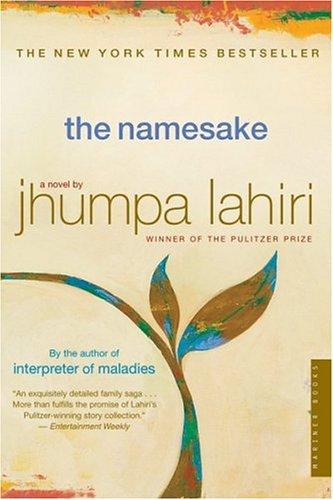
The Namesake by Jhumpa Lahiri is a 2003 literary fiction book about identity, immigration and belonging, generational conflict. The novel frames identity as something built over decades through small daily choices, not declared at a single moment of self-discovery.
Summary
The Namesake follows the Ganguli family across three decades, beginning with Ashoke and Ashima's arranged marriage and their immigration from Calcutta to Cambridge, Massachusetts, and extending into the American adulthood of their son, Gogol. Gogol — named after the Russian writer Nikolai Gogol in a story rooted in Ashoke's near-death experience — grows up resenting the name that marks him as different, eventually legally changing it to Nikhil. The novel is structured around that act and everything it costs him.
The book is ultimately about what we inherit and what we try to shed. Lahiri traces how Gogol oscillates between the Bengali world of his parents — rice and fish, faded photographs, the smell of a Calcutta kitchen in a Massachusetts suburb — and an American life of girlfriends, Manhattan apartments, and a career that has little to do with his roots. His parents' sacrifice is real but unspoken; the cost of their displacement is registered in small humiliations and persistent homesickness that Gogol cannot yet recognize as such. The title is a double meaning: the name is burden and gift, the name is also what the parents carry forward.
Lahiri writes in a spare, precise prose that accumulates weight through accretion rather than dramatic events. Time moves quickly — sometimes years in a paragraph — and the result is that the book reads like a family album, full of moments you recognize from lived experience rather than from other novels. The novel won no shortage of praise partly because it handled a story that had rarely been told with this much nuance: second-generation immigrant experience in the United States, the specific friction of Bengali American identity, and the way children absorb the dislocation their parents chose to endure.
Readers who want a plot-driven novel will be slightly disappointed — the drama is interior and cumulative, not explosive. Those who have ever felt at war with a name, a heritage, or a parent's expectations will find it deeply recognizable. Lahiri's debut collection, Interpreter of Maladies, is an easier entry point; The Namesake is slower, more diffuse, and rewards patience. Comparable in emotional register to Mohsin Hamid's The Reluctant Fundamentalist or Chimamanda Ngozi Adichie's Americanah in its interest in what assimilation costs.
Talk to The Namesake like its author wrote you back.
Get the ideas that fit your life — not generic summaries.
- Chat with the book
- Audiobook-style main ideas
- Adapts to your life and goals
- Helps you take action
Key takeaways
- 1.
The novel frames identity as something built over decades through small daily choices, not declared at a single moment of self-discovery.
- 2.
Names carry the accumulated weight of others' love, expectation, and longing. Changing your name is never a clean break.
- 3.
First-generation immigrants grieve their home in ways they often don't articulate to their children, and the children absorb the grief without understanding it.
- 4.
The distance between parents and children in immigrant families is often partly cultural and partly universal — both generations assume the other has failed to understand what matters.
- 5.
Assimilation is not neutral: what you gain in belonging you often pay for in a disconnection from something real and particular about where you came from.
- 6.
Lahiri presents American freedom not as unambiguously positive — Gogol's freedom to reinvent himself is also a freedom to drift and lose his moorings.
- 7.
The novel quietly argues that the stories we inherit — about where we came from, about our families' sacrifices — only become legible to us after loss, if at all.
- 8.
Place functions like a character in Lahiri's work: the Ganguli house in the suburbs is a kind of emotional archive that Gogol only appreciates when it's about to be sold.
Discussion questions
Use these on your own, with a book club, or as chat starters in Superbook. Book club version, ready to copy or print →
- 1.
Gogol hates his name throughout his adolescence and changes it as an adult. By the novel's end, does the name feel like a burden, a gift, or both? What shifts?
- 2.
Ashoke never fully explains to Gogol the story behind the name until late in the novel. Why do you think he waited? Was that the right choice?
- 3.
Ashima's homesickness for Calcutta is a constant undercurrent. How does Lahiri distinguish her experience of immigration from Ashoke's? Does either of them seem at peace?
- 4.
Gogol repeatedly chooses American partners — Ruth, Maxine, Moushumi — each of whom represents a different relationship to his Indian identity. What do those choices say about where he's trying to land?
- 5.
Maxine's family represents a certain ease with class and belonging that Gogol craves. Is the novel sympathetic to that craving, or is it critical?
- 6.
After Ashoke's death, Gogol begins to read the Gogol stories his father loved. Do you think he would have made different choices had he understood the name's significance earlier?
- 7.
The novel ends with Gogol alone, about to read the book his father gave him. Is that an ending about grief, about continuity, or about something else?
- 8.
How does the novel treat arranged marriage? Is Ashoke and Ashima's marriage presented as a model, a contrast to Gogol's relationships, or something more neutral?
- 9.
Lahiri has said she felt neither fully Indian nor fully American growing up. Does The Namesake resolve that tension, or leave it unresolved intentionally?
- 10.
The Gangulis' American suburb is rendered with affectionate precision — the colonial houses, the sari-wearing mothers, the potluck dinners. Does that specificity make the novel feel universal or particular to one community?
- 11.
Moushumi's affair late in the novel has a different quality to it than her marriage. What does Lahiri seem to be saying about the paths we choose versus the ones we feel we've escaped?
- 12.
The novel moves very quickly through time in some sections. Did that pace work for you, or did you wish Lahiri had dwelt longer in particular moments?
Themes
Frequently asked questions
-
Is The Namesake worth reading?
Yes, especially if you are interested in immigration, identity, or the experience of growing up between two cultures. It is quieter and slower than most popular literary fiction, but the accumulation of precise, recognizable detail gives it real emotional weight. If you want plot-driven fiction, it will frustrate you.
-
Is The Namesake hard to read?
No. Lahiri's prose is notably clear and unshowy — one of the most accessible writers in contemporary literary fiction. The challenge is pacing: the novel covers decades in a compressed way that requires you to do some emotional work between scenes.
-
What is The Namesake about, without spoilers?
It follows an Indian immigrant family in the United States across three decades, focusing on the son Gogol, who grows up resenting the unusual name his parents gave him. The novel is about what we inherit from our parents, what we try to escape, and what we only understand after it's too late.
-
Why is The Namesake considered an important novel?
It gave precise, novelistic form to an experience — second-generation immigrant life in America — that had rarely been treated with this level of literary seriousness. It also performs a neat trick: the Bengali American specificity makes it feel more universal rather than less.
-
Is there a film version of The Namesake?
Yes. Mira Nair directed the 2006 film adaptation with Tabu, Irrfan Khan, and Kal Penn. It is a faithful, well-reviewed adaptation that captures the novel's emotional tone, though it compresses the timeline significantly.
-
Who shouldn't read The Namesake?
Readers who need narrative momentum and dramatic conflict to stay engaged. The novel's stakes are entirely interior and its crises are quiet ones — a name changed, a relationship ending, a parent's story finally understood. If that sounds boring, it probably will be.