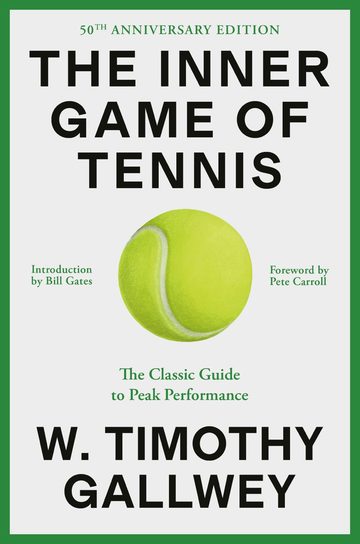
Talk to The Inner Game of Tennis like its author wrote you back.
Get the ideas that fit your life — not generic summaries.
- Chat with the book
- Audiobook-style main ideas
- Adapts to your life and goals
- Helps you take action
What it argues
The Inner Game of Tennis is Timothy Gallwey's short, influential argument that the biggest obstacle to performing and learning is not a lack of technique but the interference of our own minds. Every activity, he says, has two games: the outer game against an external challenge, and the inner game played against self-doubt, tension, and the constant judging chatter in our heads. Win the inner game and the outer one gets dramatically easier.
His central model is two selves. Self 1 is the verbal, critical ego — the voice that instructs, doubts, and condemns. Self 2 is the body and its deep, largely unconscious capacity to learn by doing, the way a child learns to walk. Most poor performance, Gallwey argues, comes from Self 1 mistrusting Self 2 and trying too hard. The skill to cultivate is relaxed concentration: quieting the judging mind so the body can do what it already knows how to do.
What it gets right
- 1.
Every performance has two games: the outer game against the opponent or task, and the inner game against your own doubt, tension, and self-judgment.
- 2.
We contain two selves — Self 1, the judging, instructing ego, and Self 2, the body that already knows how to learn by doing. Most errors come from Self 1 interfering.
- 3.
Trying too hard usually hurts. Peak performance comes from relaxed concentration, not gritted-teeth effort.
What it covers
Who wrote it
W. Timothy Gallwey is an American author and coach widely regarded as a pioneer of modern performance coaching. A Harvard graduate and former captain of its tennis team, he was teaching tennis in California in the early 1970s when he noticed that players improved most when he instructed them least. The Inner Game of Tennis, published in 1974, distilled that insight and sold more than a million copies. He went on to write inner-game books on golf, skiing, music, and work, and his ideas helped shape the executive-coaching profession that followed.
