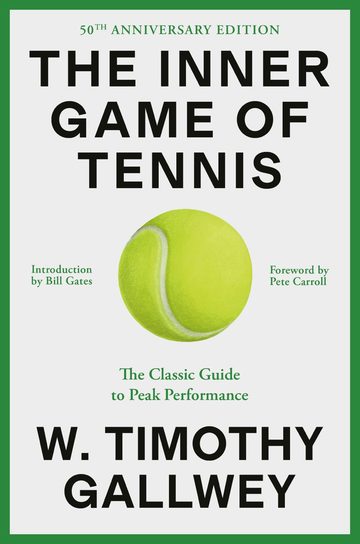
The Inner Game of Tennis by W. Timothy Gallwey is a 1974 sports psychology book about performance psychology, learning, concentration. Every performance has two games: the outer game against the opponent or task, and the inner game against your own doubt, tension, and self-judgment.
Summary
The Inner Game of Tennis is Timothy Gallwey's short, influential argument that the biggest obstacle to performing and learning is not a lack of technique but the interference of our own minds. Every activity, he says, has two games: the outer game against an external challenge, and the inner game played against self-doubt, tension, and the constant judging chatter in our heads. Win the inner game and the outer one gets dramatically easier.
His central model is two selves. Self 1 is the verbal, critical ego — the voice that instructs, doubts, and condemns. Self 2 is the body and its deep, largely unconscious capacity to learn by doing, the way a child learns to walk. Most poor performance, Gallwey argues, comes from Self 1 mistrusting Self 2 and trying too hard. The skill to cultivate is relaxed concentration: quieting the judging mind so the body can do what it already knows how to do.
The practical core is a set of techniques for getting Self 1 out of the way. The foundation is nonjudgmental awareness — observing what actually happens without labeling it good or bad, because judgment is what triggers the interference. He offers concentration tricks, like watching the seams of the ball or saying bounce and hit in rhythm, and argues that we change habits through images and feel rather than verbal self-instruction. He also reframes competition: the opponent exists to draw out your best, and winning means overcoming the obstacles within.
Though it's built around tennis, Gallwey extends the method to work, stress, and any skill, and the book became a foundational text for modern coaching. Its limits are those of its 1974 origins: it's thin, one idea stretched across a slim volume, and its psychology is experiential and anecdotal rather than rigorously scientific. But as a lens on why we choke, over-coach ourselves, and learn best when we stop trying so hard, it remains unusually clarifying.
The two games
Gallwey’s premise is that every activity is played on two levels at once. The outer game is the visible one — the opponent, the technique, the score. The inner game happens in your head, against nervousness, self-doubt, wandering attention, and the running commentary that judges every move. His claim is that most of what holds people back is lost on the inner game, not the outer one.
Self 1 and Self 2
He personifies the conflict as two selves:
- Self 1 is the conscious, verbal ego — the teller. It instructs, second-guesses, and criticizes, and it doesn’t trust the body to perform without supervision.
- Self 2 is the body and its deep, mostly unconscious intelligence — the doer. It learns the way a child learns to walk: by doing, watching, and adjusting, without a stream of verbal commands.
Poor performance, in this model, is mostly Self 1 interfering with Self 2 — trying too hard, over-instructing, and tightening up under judgment.
Quieting Self 1
The practical heart of the book is a set of ways to get the judging mind out of the body’s way.
Nonjudgmental awareness
Stop labeling outcomes as good or bad and simply observe what happened — where the ball landed, what your body actually did. Judgment is what starts the cycle of tension and over-correction; neutral attention dissolves it.
Concentration
Give Self 1 something absorbing to focus on so it has no attention left for interference. Gallwey’s players watch the seams of the ball, or say bounce as it lands and hit as they strike it, sharpening timing while quieting the mind.
Learning by feel and image
To change a movement, don’t recite instructions to yourself. Picture the outcome you want, or exaggerate and experiment, and let Self 2 find the way. Images and felt experience teach the body better than words do.
Relaxed concentration
The state Gallwey is aiming for is relaxed concentration — alert but not tense, focused but not forcing. It’s the opposite of gritted-teeth effort, and it’s where both learning and performance come most easily. Trying less, in the right way, produces more.
Beyond tennis
Though the examples come from the court, Gallwey ends by extending the inner game to the rest of life — work, stress, and any skill worth learning. He also reframes competition: the opponent isn’t an enemy but the source of the obstacles that draw out your best, and the real contest is with the interference inside your own head. The book went on to shape modern performance and executive coaching, and spawned inner-game sequels on golf, skiing, music, and work.
Talk to The Inner Game of Tennis like its author wrote you back.
Get the ideas that fit your life — not generic summaries.
- Chat with the book
- Audiobook-style main ideas
- Adapts to your life and goals
- Helps you take action
Key takeaways
- 1.
Every performance has two games: the outer game against the opponent or task, and the inner game against your own doubt, tension, and self-judgment.
- 2.
We contain two selves — Self 1, the judging, instructing ego, and Self 2, the body that already knows how to learn by doing. Most errors come from Self 1 interfering.
- 3.
Trying too hard usually hurts. Peak performance comes from relaxed concentration, not gritted-teeth effort.
- 4.
Judgment is the root problem. Labeling a shot as bad starts a cycle of tension and over-correction; neutral, nonjudgmental observation breaks it.
- 5.
Change habits through images and feel, not verbal commands. Telling yourself to bend your knees engages Self 1; showing Self 2 the desired outcome works better.
- 6.
Concentration is a tool for quieting the mind. Give attention something specific — the seams of the ball, a rhythm — and Self 1 has no room left to interfere.
- 7.
Trust the body. When you stop consciously controlling every movement and let it happen, both performance and learning improve.
- 8.
Reframe winning: your opponent creates the obstacles that draw out your potential, and the real contest is overcoming the ones inside your own head.
Discussion questions
Use these on your own, with a book club, or as chat starters in Superbook. Book club version, ready to copy or print →
- 1.
Gallwey says the inner opponent is tougher than the outer one. In an activity you care about, what does your inner opponent say to you?
- 2.
Can you recall a time you performed better when you stopped trying so hard? What allowed you to relax?
- 3.
When you make a mistake, how quickly do you judge yourself, and how does that judgment affect what happens next?
- 4.
Self 1 is the instructing, critical voice. Whose voice does yours sound like, and is it actually helping you?
- 5.
Where in your life are you over-coaching yourself with verbal instructions instead of trusting your body or your instincts?
- 6.
Gallwey teaches nonjudgmental awareness. What would it look like to simply observe your performance this week without labeling it good or bad?
- 7.
Think of a skill you learned effortlessly as a child. What was different about how you learned it then versus how you learn now?
- 8.
Relaxed concentration is the state the book aims for. When have you felt it, and what conditions seemed to produce it?
- 9.
The book claims we learn better from images and feel than from instructions. How could you use imagery to improve something you're working on?
- 10.
Gallwey reframes the opponent as someone who draws out your best. How would treating a rival or obstacle that way change how you approach it?
- 11.
Where does performance anxiety show up for you — sport, speaking, work — and how much of it is really Self 1's chatter?
- 12.
The book applies far beyond tennis. Which part of your life is most sabotaged by self-doubt, and what would quieting that voice make possible?
Themes
Frequently asked questions
-
What is The Inner Game of Tennis about?
It argues that the main barrier to performance is mental interference, not lack of skill. Gallwey introduces Self 1, the judging mind, and Self 2, the body that knows how to play, and teaches how to quiet the first so the second can perform.
-
Is The Inner Game of Tennis only for tennis players?
No. Tennis is the vehicle, but the ideas apply to any skill, sport, or high-pressure task. Gallwey extends them to work and stress, and the book is widely read by musicians, coaches, and business leaders.
-
Is The Inner Game of Tennis worth reading today?
Yes, if you struggle with self-criticism, nerves, or overthinking. Written in 1974, it's short and a little dated in tone, but its core insight about getting out of your own way has aged remarkably well.
-
Is The Inner Game of Tennis a scientific book?
Not really. Its psychology is experiential and drawn from Gallwey's coaching, not controlled research. The two-selves model is a useful metaphor rather than neuroscience, which is worth keeping in mind as you read.
-
What is the main technique in The Inner Game of Tennis?
Nonjudgmental awareness: observing what actually happens without labeling it good or bad. By dropping judgment and focusing attention on something concrete, you quiet the critical mind and let your body perform naturally.
Similar books
Effortless Mastery: Liberating the Master Musician Within
Kenny Werner
Peak: Secrets from the New Science of Expertise
Anders Ericsson and Robert Pool

Mastery
Robert Greene

The First 20 Hours
Josh Kaufman
