Psychology · Book club
The Intelligence Trap: Why Smart People Make Dumb Mistakes book club questions
Here are 12 book club questions for The Intelligence Trap: Why Smart People Make Dumb Mistakes by David Robson, ordered to open easily and end somewhere worth arguing about. Copy them, print them, or bring them up one at a time.
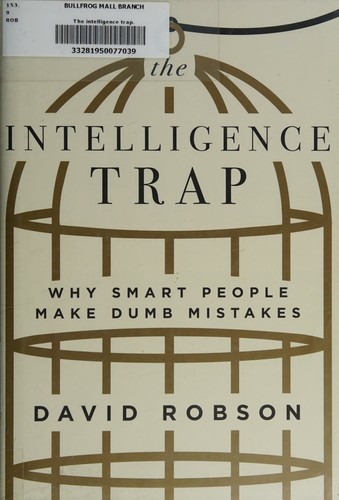
The Intelligence Trap is science journalist David Robson's investigation into a paradox: high intelligence and education do not protect against bad reasoning, and can actively make it worse.
David Robson · 2019 · 5h 15m
Full summary and key takeaways →The 12 questions
- 1.
Robson argues that the skills that make someone successful in academic or professional domains can actively worsen judgment in others. Where have you seen this play out?
- 2.
Think of a strongly held belief you have. How hard would you work to find evidence against it? What would change your mind?
- 3.
The book describes how intelligent people often have more sophisticated rationalizations for their biases. Have you noticed this in yourself or in high-intelligence people you know?
- 4.
Robson distinguishes intelligence from rationality. How would you assess your own rationality separate from your intelligence or expertise?
- 5.
The 'earned dogmatism' effect suggests that credentials can make people less open-minded in their own domain. In what area might your own expertise be limiting your thinking?
- 6.
Superforecasters do better than experts partly because they update their views frequently and without ego. Where in your own thinking are you most resistant to updating?
- 7.
The book suggests that intellectual humility is trainable. What would it look like to practice it deliberately in a professional or personal domain you care about?
- 8.
Linus Pauling's vitamin C advocacy is a case of genius misapplied. What famous example from your own field resembles this pattern?
- 9.
Actively open-minded thinking requires seeking disconfirming evidence rather than just evaluating the evidence that arrives. In your current major decisions, have you done this?
- 10.
Robson says smart people are better at motivated reasoning, not worse. What does that imply about how much weight to give to the confident judgments of intelligent friends or colleagues?
- 11.
If IQ is a poor guide to wisdom, what qualities would you actually want to see in a doctor, financial advisor, or political leader?
- 12.
The book ends with practices that improve judgment. Which of the practices Robson describes do you think would be hardest for you personally to adopt, and why?
How to run the discussion
- Pick six to eight, not all of them. An hour of real discussion covers fewer questions than anyone expects, and racing the list is what makes a book club feel like homework.
- Open with what people noticed, not what they concluded. Asking for a verdict first hardens opinions before anyone has heard each other.
- Let the disagreement run. The questions below that split a room are the ones worth the time; the ones everyone answers the same way can be skipped.
- Ask the quiet person a specific question. A direct, narrow question is far easier to answer than an open invitation to contribute.
Themes worth steering toward
If the conversation stalls, these are the threads that usually restart it.
Common questions
What are good book club questions for The Intelligence Trap: Why Smart People Make Dumb Mistakes?
Here are 12 book club questions for The Intelligence Trap: Why Smart People Make Dumb Mistakes by David Robson, ordered to open easily and end somewhere worth arguing about. The strongest openers ask what each reader noticed rather than what they concluded, and the discussion usually turns on cognitive bias, decision-making, critical thinking.
How long should a book club discussion of The Intelligence Trap: Why Smart People Make Dumb Mistakes last?
Most groups run 60 to 90 minutes of actual discussion. That is roughly six to eight questions, not all of them, so pick the ones that suit your group rather than working down the list in order.
What are the main themes in The Intelligence Trap: Why Smart People Make Dumb Mistakes?
Cognitive bias, Decision-making, Critical thinking, Intelligence, Wisdom. Those are the threads most likely to divide a room, which makes them the useful places to steer a discussion that has gone quiet.
Picking the next one? See books like The Intelligence Trap: Why Smart People Make Dumb Mistakes or questions for other book club picks.
