Economics · Book club
The Intelligent Asset Allocator book club questions
Here are 12 book club questions for The Intelligent Asset Allocator by William J. Bernstein, ordered to open easily and end somewhere worth arguing about. Copy them, print them, or bring them up one at a time.
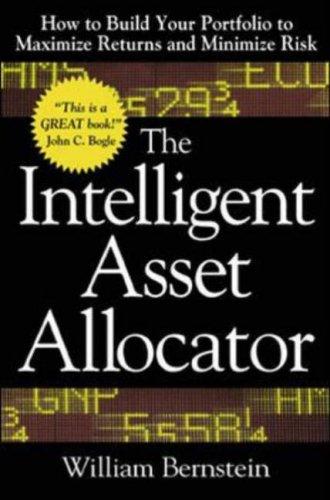
The Intelligent Asset Allocator is William Bernstein's argument that the most important decision an investor makes is not which stock to buy but how to divide a portfolio across different asset classes.
William J. Bernstein · 2000 · 3h 45m
Full summary and key takeaways →The 12 questions
- 1.
Bernstein argues asset allocation matters more than stock selection. Does that conclusion match how most investors, financial media, and advisors actually spend their time and attention?
- 2.
The book is built on historical return data. How much weight should historical patterns carry when constructing a portfolio for the next 30 years?
- 3.
What is correlation in the context of asset allocation, and why does Bernstein argue that a lower-returning asset can still improve a portfolio?
- 4.
Bernstein shows that most investors underperform the funds they invest in due to poor timing. Have you observed this pattern in your own investment behavior?
- 5.
Rebalancing requires selling assets that have done well and buying ones that have done poorly. What makes this psychologically difficult, and how does systematic rebalancing overcome it?
- 6.
The book was written in 2000. Which of Bernstein's core arguments do you think have held up in the 25 years since, and which look most vulnerable?
- 7.
Bernstein is skeptical of international diversification's benefits in more recent decades. What changed, and does his original argument still hold?
- 8.
How should a younger investor with a long time horizon think differently about portfolio construction than someone nearing retirement?
- 9.
Bernstein critiques actively managed funds largely on cost grounds. Has the rise of low-cost active ETFs changed that calculation?
- 10.
What does Bernstein mean by risk tolerance being both financial and psychological, and why does the difference matter when building a portfolio?
- 11.
If a simple three-fund portfolio captures most of the benefits Bernstein describes, what is the cost of using a more complex approach with many asset classes?
- 12.
The book argues that most investors are better off knowing less and following a simple plan. Is that a satisfying conclusion, or does it feel like a concession to human limitation?
How to run the discussion
- Pick six to eight, not all of them. An hour of real discussion covers fewer questions than anyone expects, and racing the list is what makes a book club feel like homework.
- Open with what people noticed, not what they concluded. Asking for a verdict first hardens opinions before anyone has heard each other.
- Let the disagreement run. The questions below that split a room are the ones worth the time; the ones everyone answers the same way can be skipped.
- Ask the quiet person a specific question. A direct, narrow question is far easier to answer than an open invitation to contribute.
Themes worth steering toward
If the conversation stalls, these are the threads that usually restart it.
Common questions
What are good book club questions for The Intelligent Asset Allocator?
Here are 12 book club questions for The Intelligent Asset Allocator by William J. Bernstein, ordered to open easily and end somewhere worth arguing about. The strongest openers ask what each reader noticed rather than what they concluded, and the discussion usually turns on asset allocation, portfolio construction, risk and return.
How long should a book club discussion of The Intelligent Asset Allocator last?
Most groups run 60 to 90 minutes of actual discussion. That is roughly six to eight questions, not all of them, so pick the ones that suit your group rather than working down the list in order.
What are the main themes in The Intelligent Asset Allocator?
Asset allocation, Portfolio construction, Risk and return, Diversification, Investing. Those are the threads most likely to divide a room, which makes them the useful places to steer a discussion that has gone quiet.
Picking the next one? See books like The Intelligent Asset Allocator or questions for other book club picks.
