Romance · Book club
The Kiss Quotient book club questions
Here are 11 book club questions for The Kiss Quotient by Helen Hoang, ordered to open easily and end somewhere worth arguing about. Copy them, print them, or bring them up one at a time.
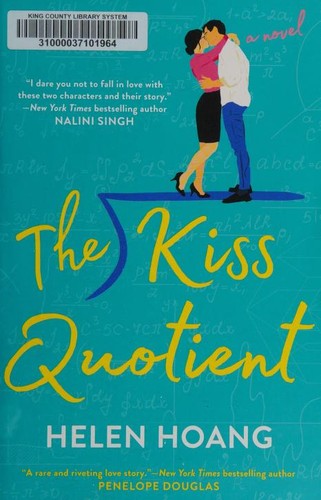
Stella Lane is a thirty-year-old econometrician with autism who is very good at her job, slightly alarmed by her mother's escalating desire for grandchildren, and reasonably certain she's bad at relationships.
Helen Hoang · 2018 · 5h 45m
Full summary and key takeaways →The 11 questions
- 1.
Stella's plan to hire Michael is, by her logic, entirely rational. Does the novel agree with her reasoning, or does it gently show her she's missed something?
- 2.
Hoang was diagnosed with autism while writing this book. How do you think that influenced the intimacy of Stella's interior monologue?
- 3.
Michael is ashamed of his escorting work in a way that mirrors Stella's shame about her social difficulties. Does the parallel feel constructed or organic?
- 4.
Stella is often the most direct person in any scene — she says what she means and expects others to do the same. How does the novel use that directness comedically versus emotionally?
- 5.
The romance requires Michael to eventually reckon with whether he's been honest with Stella about his feelings. Given Stella's need for explicit communication, what are the stakes of his evasiveness?
- 6.
The Vietnamese-American family scenes give Michael's character cultural grounding beyond his individual psychology. Does the novel succeed in making those feel integral rather than decorative?
- 7.
Stella's mother wants grandchildren; Michael's family has specific expectations too. How do the family pressures in this book compare to how family usually functions in romance?
- 8.
The Kiss Quotient was credited with changing the romance landscape around neurodiverse representation. What responsibility do authors have when they write protagonists with identities they share, and what when they don't?
- 9.
Is the book's HEA (happily ever after) satisfying precisely because Stella has changed, or because the world around her has accommodated her?
- 10.
The escorting setup is uncommon in mainstream romance. How does the novel navigate the power and vulnerability dynamics it introduces?
- 11.
Would this book read differently if Stella were neurotypical? What would be lost?
How to run the discussion
- Pick six to eight, not all of them. An hour of real discussion covers fewer questions than anyone expects, and racing the list is what makes a book club feel like homework.
- Open with what people noticed, not what they concluded. Asking for a verdict first hardens opinions before anyone has heard each other.
- Let the disagreement run. The questions below that split a room are the ones worth the time; the ones everyone answers the same way can be skipped.
- Ask the quiet person a specific question. A direct, narrow question is far easier to answer than an open invitation to contribute.
Themes worth steering toward
If the conversation stalls, these are the threads that usually restart it.
Common questions
What are good book club questions for The Kiss Quotient?
Here are 11 book club questions for The Kiss Quotient by Helen Hoang, ordered to open easily and end somewhere worth arguing about. The strongest openers ask what each reader noticed rather than what they concluded, and the discussion usually turns on autism and intimacy, shame and self-acceptance, class and family obligation.
How long should a book club discussion of The Kiss Quotient last?
Most groups run 60 to 90 minutes of actual discussion. That is roughly six to eight questions, not all of them, so pick the ones that suit your group rather than working down the list in order.
What are the main themes in The Kiss Quotient?
Autism and intimacy, Shame and self-acceptance, Class and family obligation, Vulnerability, Neurodiverse experience. Those are the threads most likely to divide a room, which makes them the useful places to steer a discussion that has gone quiet.
Picking the next one? See books like The Kiss Quotient or questions for other book club picks.
