Literary fiction · Book club
The Lacuna book club questions
Here are 11 book club questions for The Lacuna by Barbara Kingsolver, ordered to open easily and end somewhere worth arguing about. Copy them, print them, or bring them up one at a time.
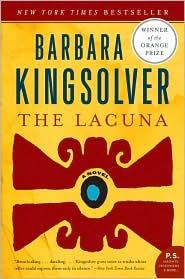
The Lacuna follows Harrison William Shepherd, a half-Mexican, half-American man who in the 1930s works as a cook in the household of Diego Rivera and Frida Kahlo in Mexico City, and eventually becomes secretary to Leon Trotsky during his Mexican exile.
Barbara Kingsolver · 2009 · 10h 40m
Full summary and key takeaways →The 11 questions
- 1.
The archive structure includes editorial annotations from Mrs. Brown. How does her presence as an archival voice change the way you read Shepherd's journals?
- 2.
Kingsolver's Rivera and Kahlo are obviously drawn from biography. Did you find the fictional rendering of historical figures plausible, or did it create a dissonance you couldn't fully resolve?
- 3.
Trotsky in the novel is drawn with ambivalence — intellectually formidable, humanly rigid. Does Kingsolver's Trotsky feel like a considered portrait or a convenience?
- 4.
The lacuna image recurs throughout: underwater passages, gaps in the archive, the things public narrative erases. Does the symbol do enough work, or does it eventually feel overloaded?
- 5.
Shepherd's novels become bestsellers in part because Americans want historical fiction that redeems the Aztec past. What is Kingsolver saying about the relationship between popular fiction and national self-image?
- 6.
The Red Scare sections feel more contemporary than the 1940s Mexican sections. Is that because Kingsolver wrote the 2009 book partly as a response to post-9/11 political culture?
- 7.
Mrs. Brown's loyalty to Shepherd extends to preserving an archive he never authorized. Is her act one of love, or a kind of appropriation of his story?
- 8.
Compare the treatment of McCarthyism here to how you've encountered it in other fiction or history. Does Kingsolver add to your understanding of it, or primarily dramatize what you already knew?
- 9.
The novel's structure suggests that what gets recorded determines what is remembered. Is Kingsolver optimistic about archives, or does the lacuna ultimately swallow everything?
- 10.
The Lacuna is a less commercially successful book than The Poisonwood Bible. Does the more cerebral register feel like Kingsolver taking a risk, or a missed calibration?
- 11.
What does the novel say about the cost of being a public figure — whether a novelist, a revolutionary, or an artist — in a culture that needs enemies?
How to run the discussion
- Pick six to eight, not all of them. An hour of real discussion covers fewer questions than anyone expects, and racing the list is what makes a book club feel like homework.
- Open with what people noticed, not what they concluded. Asking for a verdict first hardens opinions before anyone has heard each other.
- Let the disagreement run. The questions below that split a room are the ones worth the time; the ones everyone answers the same way can be skipped.
- Ask the quiet person a specific question. A direct, narrow question is far easier to answer than an open invitation to contribute.
Themes worth steering toward
If the conversation stalls, these are the threads that usually restart it.
Common questions
What are good book club questions for The Lacuna?
Here are 11 book club questions for The Lacuna by Barbara Kingsolver, ordered to open easily and end somewhere worth arguing about. The strongest openers ask what each reader noticed rather than what they concluded, and the discussion usually turns on art and censorship, historical amnesia, identity and self-invention.
How long should a book club discussion of The Lacuna last?
Most groups run 60 to 90 minutes of actual discussion. That is roughly six to eight questions, not all of them, so pick the ones that suit your group rather than working down the list in order.
What are the main themes in The Lacuna?
Art and censorship, Historical amnesia, Identity and self-invention, McCarthyism and political persecution, Truth and narrative. Those are the threads most likely to divide a room, which makes them the useful places to steer a discussion that has gone quiet.
Picking the next one? See books like The Lacuna or questions for other book club picks.
