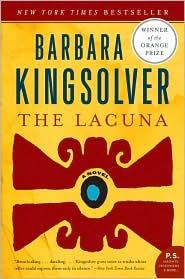
Talk to The Lacuna like its author wrote you back.
Get the ideas that fit your life — not generic summaries.
- Chat with the book
- Audiobook-style main ideas
- Adapts to your life and goals
- Helps you take action
What it argues
The Lacuna follows Harrison William Shepherd, a half-Mexican, half-American man who in the 1930s works as a cook in the household of Diego Rivera and Frida Kahlo in Mexico City, and eventually becomes secretary to Leon Trotsky during his Mexican exile. After Trotsky's assassination in 1940, Shepherd returns to the United States, where he becomes a bestselling historical novelist — and where, in the Red Scare of the late 1940s, he is destroyed by exactly the forces he had spent his career trying to document in fiction.
Kingsolver's novel is structured as an archive: journals, newspaper clippings, letters, transcripts of testimony, a secretary's retrospective annotations. The "lacuna" is both the underwater cave Shepherd discovers as a boy (a passage that closes as the tide rises) and the gaps in the historical record — the things that don't make it into newspaper accounts, the versions of people that public narrative erases. The Rivera-Kahlo household is rendered with color and warmth; Trotsky's household is rendered with intellectual rigidity and fear. Both prepare Shepherd for what America will do to him.
What it gets right
- 1.
The archive structure — journals, newspaper clippings, legal transcripts — is not decorative. It makes the novel's argument about narrative power visible at the level of form.
- 2.
The 'lacuna' is simultaneously a physical space (the underwater cave), a narrative gap, and a metaphor for what public history omits. Kingsolver develops all three without forcing them to collapse into one.
- 3.
The Rivera-Kahlo sections are the novel's warmest. Kingsolver uses them to show what creative freedom looks like before the Red Scare systematically destroys that freedom in the American sections.
What it covers
Who wrote it
Barbara Kingsolver is an American novelist, essayist, and poet who grew up in rural Kentucky and lived in Mexico as a child. She has a graduate degree in biology and her fiction consistently engages ecology, politics, and social justice. The Lacuna won the Orange Prize for Fiction in 2010. Her other major novels include The Poisonwood Bible, Prodigal Summer, and Demon Copperhead, which won the 2023 Pulitzer Prize. She lives on a farm in Virginia.
