Talk to The Language of Things like its author wrote you back.
Get the ideas that fit your life — not generic summaries.
- Chat with the book
- Audiobook-style main ideas
- Adapts to your life and goals
- Helps you take action
The Language of Things, in detail
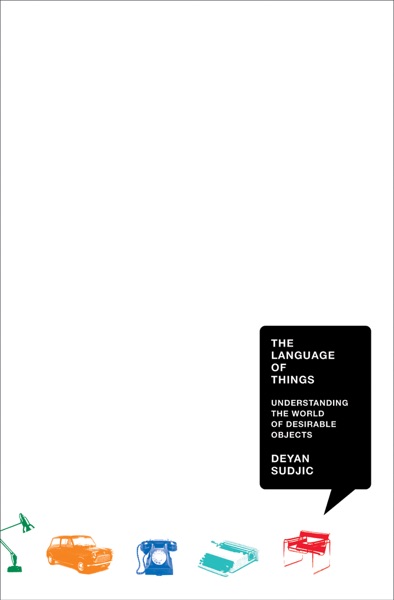
The Language of Things is Deyan Sudjic's examination of how designed objects communicate — not just what they are functionally, but what they say about identity, desire, status, and culture. Sudjic, the longtime director of the Design Museum in London, draws on decades of writing about design to argue that objects have a rhetoric, and that understanding it changes how you see the things around you.
The book moves through a series of lenses. Fashion and luxury goods establish a baseline: these are objects where the communicative function is openly acknowledged. A Hermès bag is not primarily about carrying things. Sudjic extends the analysis to objects where the rhetorical dimension is less obvious — modernist furniture, mass-market electronics, military hardware, cars, architecture. In each case he asks: what is this object claiming about the person who owns or uses it, and how does its design make that claim?
Sudjic is particularly sharp on the ideology embedded in design movements. Modernism, he argues, was not simply a style — it was a claim about honesty, democracy, and the elimination of false ornament. That claim was always partly rhetorical. A Braun radio and an Eames chair communicate precisely as much as a piece of Victorian furniture, just in a different direction. The assertion that function drives form is itself a form of content, as Ben Shahn might have said. Modernism sold simplicity as a virtue, but simplicity is no less a style than baroque decoration.
The book is relatively short and essayistic, and Sudjic resists providing a definitive theory. He's more interested in sharpening the reader's attention than in constructing a system. That approach suits the subject — the semiotics of objects are genuinely complicated and resist tidy frameworks — but readers looking for analytical rigor may find the argument too loose. What The Language of Things does well is to make the unconscious vocabulary of designed objects visible, so that you can read a room the way you might read a sentence.
The big ideas
- 1.
Every designed object communicates something beyond its function. Understanding that communication is a form of literacy that changes how you experience the built environment.
- 2.
Luxury goods are the most honest about this: nobody pretends a Hermès bag is primarily about carrying things. The communicative function is the point.
- 3.
Modernism embedded a rhetoric in its aesthetic: honesty, democracy, anti-ornament. That rhetoric is no less a style or a claim than the rococo it displaced.
