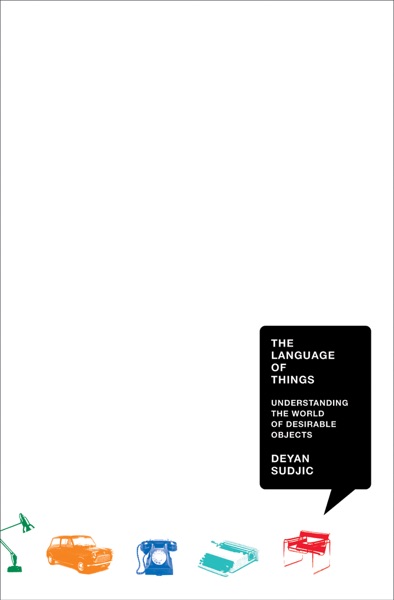
The Language of Things by Deyan Sudjic is a 2008 philosophy book about design, objects and meaning, consumer culture. Every designed object communicates something beyond its function. Understanding that communication is a form of literacy that changes how you experience the built environment.
Summary
The Language of Things is Deyan Sudjic's examination of how designed objects communicate — not just what they are functionally, but what they say about identity, desire, status, and culture. Sudjic, the longtime director of the Design Museum in London, draws on decades of writing about design to argue that objects have a rhetoric, and that understanding it changes how you see the things around you.
The book moves through a series of lenses. Fashion and luxury goods establish a baseline: these are objects where the communicative function is openly acknowledged. A Hermès bag is not primarily about carrying things. Sudjic extends the analysis to objects where the rhetorical dimension is less obvious — modernist furniture, mass-market electronics, military hardware, cars, architecture. In each case he asks: what is this object claiming about the person who owns or uses it, and how does its design make that claim?
Sudjic is particularly sharp on the ideology embedded in design movements. Modernism, he argues, was not simply a style — it was a claim about honesty, democracy, and the elimination of false ornament. That claim was always partly rhetorical. A Braun radio and an Eames chair communicate precisely as much as a piece of Victorian furniture, just in a different direction. The assertion that function drives form is itself a form of content, as Ben Shahn might have said. Modernism sold simplicity as a virtue, but simplicity is no less a style than baroque decoration.
The book is relatively short and essayistic, and Sudjic resists providing a definitive theory. He's more interested in sharpening the reader's attention than in constructing a system. That approach suits the subject — the semiotics of objects are genuinely complicated and resist tidy frameworks — but readers looking for analytical rigor may find the argument too loose. What The Language of Things does well is to make the unconscious vocabulary of designed objects visible, so that you can read a room the way you might read a sentence.
Talk to The Language of Things like its author wrote you back.
Get the ideas that fit your life — not generic summaries.
- Chat with the book
- Audiobook-style main ideas
- Adapts to your life and goals
- Helps you take action
Key takeaways
- 1.
Every designed object communicates something beyond its function. Understanding that communication is a form of literacy that changes how you experience the built environment.
- 2.
Luxury goods are the most honest about this: nobody pretends a Hermès bag is primarily about carrying things. The communicative function is the point.
- 3.
Modernism embedded a rhetoric in its aesthetic: honesty, democracy, anti-ornament. That rhetoric is no less a style or a claim than the rococo it displaced.
- 4.
Objects are used to manage identity — to signal belonging, aspiration, or rejection of status. Design engineers those signals, often deliberately.
- 5.
Military design is among the most rigorous functional design, and it has consistently influenced civilian aesthetic. The Jeep, the aviator watch, the trench coat all carry traces of their origins.
- 6.
The gap between what an object is designed to do and what it actually communicates is where most of the interesting design analysis lives.
- 7.
Sudjic argues that design literacy — the ability to read what objects claim — is increasingly necessary in a world saturated with consciously designed environments.
Discussion questions
Use these on your own, with a book club, or as chat starters in Superbook. Book club version, ready to copy or print →
- 1.
Sudjic argues that all designed objects have a rhetoric. What does the most recently designed thing in your home say about you to someone who can read it?
- 2.
He claims modernism was not a neutral style but an ideology dressed as honesty. Do you find that convincing, or does it prove too much?
- 3.
Luxury brands are explicit about the communicative function of their goods. Is that more honest than mainstream brands who obscure it, or just more cynical?
- 4.
Sudjic traces civilian design back to military origins — watches, backpacks, clothing. Does knowing that change how you feel about the objects?
- 5.
The book argues that objects manage identity — that we use them to signal belonging or aspiration. Which objects in your own life are doing that work most visibly?
- 6.
When does designing for communication become manipulation? Is there a meaningful line between design that informs and design that seduces?
- 7.
He writes about the Design Museum's collection choices. What would belong in a museum of your current moment's design culture?
- 8.
Sudjic is deliberately essayistic rather than systematic. Does that make the book more readable or less convincing?
- 9.
The book was published in 2008. Which objects from the last fifteen years do you think most needed this kind of analysis?
- 10.
If objects communicate, what does the design of a typical smartphone communicate about how technology companies see their users?
- 11.
Sudjic identifies a gap between what something is designed to do and what it communicates. Can you think of an example where that gap is particularly large or particularly honest?
Themes
Frequently asked questions
-
What is The Language of Things about?
It's Deyan Sudjic's argument that designed objects communicate — they carry rhetoric about identity, status, desire, and ideology — and that learning to read that communication changes how you understand the environment around you.
-
Is The Language of Things worth reading for designers?
Yes. It provides a critical vocabulary for thinking about what objects mean beyond their function, which is useful both for designers trying to work more consciously and for anyone trying to evaluate the work they consume.
-
How long is The Language of Things?
It's a short book, around 210 pages, that reads in about three hours. The chapters are essays that can be read independently, though they build on each other.
-
What's Sudjic's take on modernist design?
He argues that modernism — Bauhaus, Braun, Eames — encoded a specific ideology about honesty and democracy into its aesthetic. That ideology is itself a rhetorical stance, not a neutral description of function. Simplicity communicates as loudly as ornament, just differently.
-
Who should read The Language of Things?
Designers, architects, brand strategists, and anyone curious about why we want the objects we want. It's a short, readable book that sharpens attention to the communicative dimension of design without requiring a background in semiotics or theory.
Similar books
The Design of Everyday Things
Donald Norman
Experiencing Architecture
Steen Eiler Rasmussen
The Shape of Content
Ben Shahn
The Age of Surveillance Capitalism: The Fight for a Human Future at the New Frontier of Power
Shoshana Zuboff
