History · Book club
The Last Days of Night book club questions
Here are 12 book club questions for The Last Days of Night by Graham Moore, ordered to open easily and end somewhere worth arguing about. Copy them, print them, or bring them up one at a time.
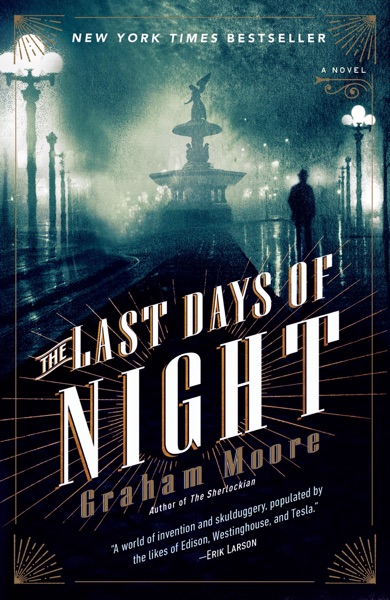
The Last Days of Night is Graham Moore's historical novel about the legal and commercial war between Thomas Edison and George Westinghouse over the electrification of America.
Graham Moore · 2016 · 6h 20m
Full summary and key takeaways →The 12 questions
- 1.
Moore argues that legal strategy shaped the electrification of America as much as engineering did. Does that framing change how you think about technological change today?
- 2.
Paul Cravath is young, inexperienced, and hired partly because senior lawyers refused the case. What does the novel suggest about how outsiders make moves that insiders won't?
- 3.
Edison uses fear — specifically, public demonstrations of electrocution — to damage Westinghouse's business. How does this tactic compare to competitive strategies you've seen in contemporary industries?
- 4.
Tesla is portrayed as someone whose technical brilliance was consistently undermined by his inability to manage relationships and money. Is that a fair reading of the historical record, or does the novel oversimplify him?
- 5.
Westinghouse is presented as the more principled of the two main antagonists — he treats workers better, he's more honest about his patents. Does he come across as genuinely ethical, or just strategically decent?
- 6.
Moore fictionalized several elements, including the romance with Agnes Huntington. Does the license historical fiction takes bother you, or do you accept it as the price of narrative engagement?
- 7.
The novel is told from Paul Cravath's point of view rather than Edison's or Tesla's. What does that choice give you that a more famous narrator wouldn't?
- 8.
The electric chair appears as a direct product of the War of Currents — a technology invented as a competitive weapon. What does that suggest about how we should evaluate the social effects of technological competition?
- 9.
What does the book say about intellectual property law? Is the patent system as Moore depicts it in the 1880s a reasonable way to reward invention, or is it better understood as a barrier to progress?
- 10.
Cravath's success comes partly from his willingness to work in ways his senior colleagues considered beneath them. What does the novel say about the relationship between pride and effectiveness?
- 11.
By the end of the book, who do you think actually won the War of Currents? Edison lost the technical battle, but how does Moore evaluate his legacy?
- 12.
If you were advising Nikola Tesla at the moment he sold his patents, what would you have told him? Was there a better path?
How to run the discussion
- Pick six to eight, not all of them. An hour of real discussion covers fewer questions than anyone expects, and racing the list is what makes a book club feel like homework.
- Open with what people noticed, not what they concluded. Asking for a verdict first hardens opinions before anyone has heard each other.
- Let the disagreement run. The questions below that split a room are the ones worth the time; the ones everyone answers the same way can be skipped.
- Ask the quiet person a specific question. A direct, narrow question is far easier to answer than an open invitation to contribute.
Themes worth steering toward
If the conversation stalls, these are the threads that usually restart it.
Common questions
What are good book club questions for The Last Days of Night?
Here are 12 book club questions for The Last Days of Night by Graham Moore, ordered to open easily and end somewhere worth arguing about. The strongest openers ask what each reader noticed rather than what they concluded, and the discussion usually turns on invention, patent law, ambition.
How long should a book club discussion of The Last Days of Night last?
Most groups run 60 to 90 minutes of actual discussion. That is roughly six to eight questions, not all of them, so pick the ones that suit your group rather than working down the list in order.
What are the main themes in The Last Days of Night?
Invention, Patent law, Ambition, Business rivalry, Innovation. Those are the threads most likely to divide a room, which makes them the useful places to steer a discussion that has gone quiet.
Picking the next one? See books like The Last Days of Night or questions for other book club picks.
