Science fiction · Book club
The Lathe of Heaven book club questions
Here are 12 book club questions for The Lathe of Heaven by Ursula K. Le Guin, ordered to open easily and end somewhere worth arguing about. Copy them, print them, or bring them up one at a time.
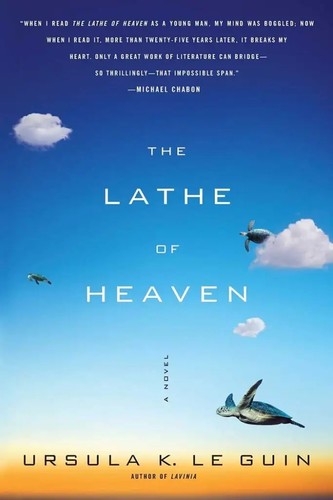
George Orr has a problem: his dreams come true.
Ursula K. Le Guin · 1971 · 4h 0m
Full summary and key takeaways →The 12 questions
- 1.
Haber's intentions are good throughout. Does the novel argue that good intentions are insufficient, or that they are actually part of the problem?
- 2.
Orr refuses to use his own dreaming purposefully. Is that refusal ethical passivity or ethical wisdom? Does Le Guin think there's a difference?
- 3.
Each of Haber's corrections creates new disasters. Is that a comment on the particular kind of correction (utopian thinking), or a broader claim about changing the world at all?
- 4.
The book's Taoist framework says: stop forcing outcomes, work with what is. Applied to real-world politics, is that position defensible or is it a counsel of complacency?
- 5.
Heather's role is partly to provide an emotional anchor to a disappearing world. Does her character carry the weight that function requires, or is she underserved by the book's length?
- 6.
The alien Aldebaranians experience time and reality differently. What does their presence add to the argument about power and consent that the Haber-Orr dynamic alone doesn't provide?
- 7.
Compared to other SF novels about reality manipulation (Dick's The Man in the High Castle, say), where does Le Guin's philosophical position land differently?
- 8.
The climax involves Orr finally dreaming without Haber's direction. What does the result suggest about what the novel thinks 'natural' outcomes look like — and is that vision satisfying?
- 9.
This is a 1971 novel set in an ecologically damaged near-future city. Did it feel dated, prescient, or both?
- 10.
Le Guin almost never writes heroes — she writes people navigating power structures. How does that authorial stance shape who you end up sympathizing with here?
- 11.
Orr is a passive protagonist in a story about power. Is that a risk that the novel manages well, or does his passivity make him hard to inhabit?
- 12.
The book endorses humility in the face of complex systems. What are the limits of that position?
How to run the discussion
- Pick six to eight, not all of them. An hour of real discussion covers fewer questions than anyone expects, and racing the list is what makes a book club feel like homework.
- Open with what people noticed, not what they concluded. Asking for a verdict first hardens opinions before anyone has heard each other.
- Let the disagreement run. The questions below that split a room are the ones worth the time; the ones everyone answers the same way can be skipped.
- Ask the quiet person a specific question. A direct, narrow question is far easier to answer than an open invitation to contribute.
Themes worth steering toward
If the conversation stalls, these are the threads that usually restart it.
Common questions
What are good book club questions for The Lathe of Heaven?
Here are 12 book club questions for The Lathe of Heaven by Ursula K. Le Guin, ordered to open easily and end somewhere worth arguing about. The strongest openers ask what each reader noticed rather than what they concluded, and the discussion usually turns on power and unintended consequences, hubris, consent and autonomy.
How long should a book club discussion of The Lathe of Heaven last?
Most groups run 60 to 90 minutes of actual discussion. That is roughly six to eight questions, not all of them, so pick the ones that suit your group rather than working down the list in order.
What are the main themes in The Lathe of Heaven?
Power and unintended consequences, Hubris, Consent and autonomy, The limits of utopia, Reality and dreaming. Those are the threads most likely to divide a room, which makes them the useful places to steer a discussion that has gone quiet.
Picking the next one? See books like The Lathe of Heaven or questions for other book club picks.
