History · Book club
The Lessons of History book club questions
Here are 12 book club questions for The Lessons of History by Will & Ariel Durant, ordered to open easily and end somewhere worth arguing about. Copy them, print them, or bring them up one at a time.
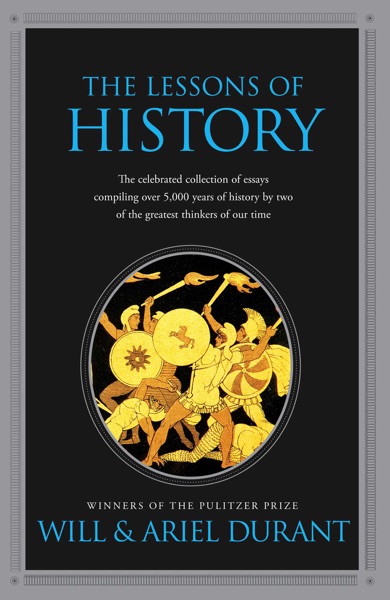
The Lessons of History is the Durants' distillation of their eleven-volume The Story of Civilization — a project that consumed forty years — into a slim, hundred-page essay.
Will & Ariel Durant · 1968 · 2h 30m
Full summary and key takeaways →The 12 questions
- 1.
The Durants argue inequality is a permanent feature of civilizations, not a correctable malfunction. Do you find this persuasive, or does it conflate what is with what must be?
- 2.
They claim moral codes have always been tied to the conditions of survival, not to eternal truths. What would that imply for moral arguments made today?
- 3.
The book treats religion as socially necessary even when factually doubtful. Is that a tenable position, or does it require defending something on false grounds?
- 4.
The Durants say every redistribution of wealth is reversed within a generation. What historical examples would you challenge them with?
- 5.
They describe democracy as rare and difficult to sustain. What conditions in your own country seem to support or undermine democratic stability right now?
- 6.
The chapter on war suggests states are always in some state of preparation for conflict. How does that framing change how you read current international news?
- 7.
The Durants write as cultural optimists despite everything they knew about the twentieth century. Is that optimism earned or is it a failure of nerve?
- 8.
They argue that history does not repeat but rhymes. Which contemporary situation most closely rhymes with something you recognize from their account?
- 9.
The book is explicitly a distillation of the Durants' eleven-volume series. Does that origin make it more trustworthy, or does compression inevitably distort?
- 10.
They treat capitalism and socialism as tendencies in tension rather than as opposed systems. How does that framing change how you think about economic debates?
- 11.
The book was written in 1968. Which of its observations seem dated, and which seem like they could have been written last year?
- 12.
The Durants say progress is real because each generation inherits accumulated knowledge. Is inherited knowledge the same as progress in human character?
How to run the discussion
- Pick six to eight, not all of them. An hour of real discussion covers fewer questions than anyone expects, and racing the list is what makes a book club feel like homework.
- Open with what people noticed, not what they concluded. Asking for a verdict first hardens opinions before anyone has heard each other.
- Let the disagreement run. The questions below that split a room are the ones worth the time; the ones everyone answers the same way can be skipped.
- Ask the quiet person a specific question. A direct, narrow question is far easier to answer than an open invitation to contribute.
Themes worth steering toward
If the conversation stalls, these are the threads that usually restart it.
Common questions
What are good book club questions for The Lessons of History?
Here are 12 book club questions for The Lessons of History by Will & Ariel Durant, ordered to open easily and end somewhere worth arguing about. The strongest openers ask what each reader noticed rather than what they concluded, and the discussion usually turns on civilizations, human nature, progress.
How long should a book club discussion of The Lessons of History last?
Most groups run 60 to 90 minutes of actual discussion. That is roughly six to eight questions, not all of them, so pick the ones that suit your group rather than working down the list in order.
What are the main themes in The Lessons of History?
Civilizations, Human nature, Progress, Power, Morality. Those are the threads most likely to divide a room, which makes them the useful places to steer a discussion that has gone quiet.
Picking the next one? See books like The Lessons of History or questions for other book club picks.
