Economics · Book club
The Little Book of Main Street Money book club questions
Here are 11 book club questions for The Little Book of Main Street Money by Jonathan Clements, ordered to open easily and end somewhere worth arguing about. Copy them, print them, or bring them up one at a time.
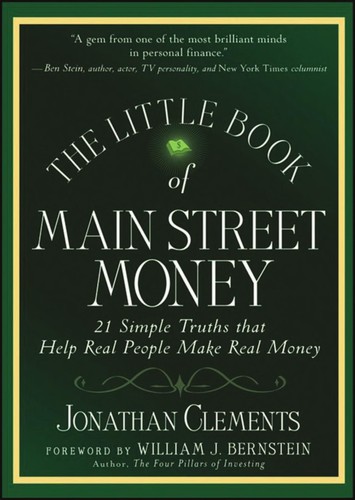
The Little Book of Main Street Money is Jonathan Clements's attempt to strip personal finance down to what actually matters for ordinary people — not market timing, not stock picking, not exotic instruments, but the unglamorous fundamentals that determine whether most households build wealth or spend their lives financially fragile.
Jonathan Clements · 2009 · 3h 40m
Full summary and key takeaways →The 11 questions
- 1.
Clements argues behavior matters more than knowledge in personal finance. What's the largest gap between what you know you should do and what you actually do?
- 2.
How does your current savings rate compare to what you believe is adequate? What would it take to close that gap by five percentage points?
- 3.
He's skeptical about homeownership as wealth-building. How did you arrive at your own view on buying versus renting, and is it based on numbers or received wisdom?
- 4.
What financial product or practice do you maintain out of habit or convention rather than because you've examined its actual cost-benefit?
- 5.
Clements says spending has a weak link to happiness. Think of a major purchase in the last three years. Does the reality match the anticipated satisfaction?
- 6.
Do you know your total investment costs — the expense ratios and fees across all accounts? What would change if you reduced them by half a percentage point?
- 7.
What insurance do you carry that might be the wrong deductible level or coverage type? When did you last review it?
- 8.
He talks about financial anchors — reference points that distort decisions. What anchors affect how you think about your salary, home value, or portfolio?
- 9.
What financial habit — one specific behavior — would most improve your long-term situation if you changed it this month?
- 10.
How do you handle market downturns emotionally? Has panic or over-optimism ever cost you measurably?
- 11.
Clements writes from the perspective of someone who spent decades watching people make financial mistakes. What financial mistake do you most want to avoid repeating?
How to run the discussion
- Pick six to eight, not all of them. An hour of real discussion covers fewer questions than anyone expects, and racing the list is what makes a book club feel like homework.
- Open with what people noticed, not what they concluded. Asking for a verdict first hardens opinions before anyone has heard each other.
- Let the disagreement run. The questions below that split a room are the ones worth the time; the ones everyone answers the same way can be skipped.
- Ask the quiet person a specific question. A direct, narrow question is far easier to answer than an open invitation to contribute.
Themes worth steering toward
If the conversation stalls, these are the threads that usually restart it.
Common questions
What are good book club questions for The Little Book of Main Street Money?
Here are 11 book club questions for The Little Book of Main Street Money by Jonathan Clements, ordered to open easily and end somewhere worth arguing about. The strongest openers ask what each reader noticed rather than what they concluded, and the discussion usually turns on personal finance, investing, behavioral finance.
How long should a book club discussion of The Little Book of Main Street Money last?
Most groups run 60 to 90 minutes of actual discussion. That is roughly six to eight questions, not all of them, so pick the ones that suit your group rather than working down the list in order.
What are the main themes in The Little Book of Main Street Money?
Personal finance, Investing, Behavioral finance, Frugality, Retirement planning. Those are the threads most likely to divide a room, which makes them the useful places to steer a discussion that has gone quiet.
Picking the next one? See books like The Little Book of Main Street Money or questions for other book club picks.
