Memoir · Book club
The Lost City of Z book club questions
Here are 11 book club questions for The Lost City of Z by David Grann, ordered to open easily and end somewhere worth arguing about. Copy them, print them, or bring them up one at a time.
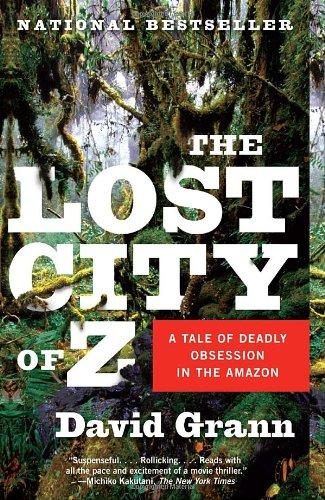
David Grann's account of the British explorer Percy Fawcett's disappearance in the Amazon in 1925 — and of Grann's own journey into the jungle to investigate — is one of the most compelling works of narrative journalism of the 2000s.
David Grann · 2009 · 6h 20m
Full summary and key takeaways →The 11 questions
- 1.
Fawcett was convinced Z existed. Grann's research suggests something like it may have. Does the book's ambiguous resolution feel satisfying, or does it frustrate you?
- 2.
Grann includes himself as a bumbling narrative presence. Does this self-deprecation serve the story, or does it sometimes feel like a way of avoiding the difficulty of the material?
- 3.
Fawcett held racial views characteristic of his era. How does Grann handle the imperial assumptions of his subject? Does he get the balance right?
- 4.
Many people have died searching for Fawcett. At what point does the search for a missing explorer become irresponsible romanticism?
- 5.
The book argues that the Amazon harbored sophisticated pre-Columbian civilizations. What are the implications of this for how we understand history?
- 6.
Fawcett took his twenty-two-year-old son Jack on the final expedition. What does the book suggest about his responsibility as a father?
- 7.
How does Grann generate tension when the reader already knows Fawcett never came back?
- 8.
The double narrative structure — Fawcett's story and Grann's investigation — is a common device in narrative journalism. Does it work here, or does Grann's story sometimes feel like a distraction?
- 9.
What does the Fawcett story suggest about the relationship between obsession and achievement? Is obsession necessary for important discovery?
- 10.
The indigenous peoples of the Amazon are present throughout the book but not always as full subjects. Does Grann do enough to render them as people rather than obstacles or helpers?
- 11.
The book was adapted into a film. Does that knowledge affect how you imagine the characters?
How to run the discussion
- Pick six to eight, not all of them. An hour of real discussion covers fewer questions than anyone expects, and racing the list is what makes a book club feel like homework.
- Open with what people noticed, not what they concluded. Asking for a verdict first hardens opinions before anyone has heard each other.
- Let the disagreement run. The questions below that split a room are the ones worth the time; the ones everyone answers the same way can be skipped.
- Ask the quiet person a specific question. A direct, narrow question is far easier to answer than an open invitation to contribute.
Themes worth steering toward
If the conversation stalls, these are the threads that usually restart it.
Common questions
What are good book club questions for The Lost City of Z?
Here are 11 book club questions for The Lost City of Z by David Grann, ordered to open easily and end somewhere worth arguing about. The strongest openers ask what each reader noticed rather than what they concluded, and the discussion usually turns on exploration, obsession, amazon.
How long should a book club discussion of The Lost City of Z last?
Most groups run 60 to 90 minutes of actual discussion. That is roughly six to eight questions, not all of them, so pick the ones that suit your group rather than working down the list in order.
What are the main themes in The Lost City of Z?
Exploration, Obsession, Amazon, Mystery, History. Those are the threads most likely to divide a room, which makes them the useful places to steer a discussion that has gone quiet.
Picking the next one? See books like The Lost City of Z or questions for other book club picks.
