History · Book club
The Making of the Atomic Bomb book club questions
Here are 12 book club questions for The Making of the Atomic Bomb by Richard Rhodes, ordered to open easily and end somewhere worth arguing about. Copy them, print them, or bring them up one at a time.
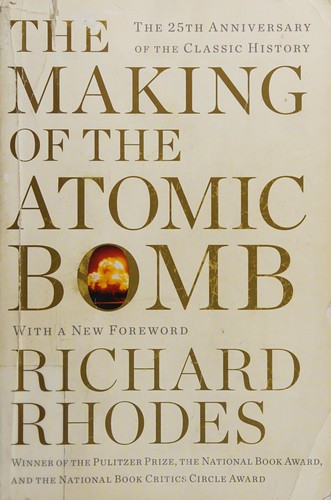
Richard Rhodes spent years researching the scientific and political story behind the Manhattan Project, and the result is a work of narrative history that refuses to treat the bomb as either a triumph or a horror to be judged from a comfortable distance.
Richard Rhodes · 1986 · 13h 15m
Full summary and key takeaways →The 12 questions
- 1.
Rhodes traces the bomb's origin to theoretical physics developed decades before the war. At what point, if any, was it still possible to prevent the bomb from being built?
- 2.
How does Rhodes's portrayal of Oppenheimer compare to the popular image of him? What does the book add or complicate?
- 3.
The refugee scientists who built the bomb were fleeing fascism in Europe. How does their motivation compare to the motivations of American military and political leaders who directed the project?
- 4.
Rhodes argues that the decision to bomb Hiroshima was made with surprisingly little deliberation. Does his account change how you think about the morality of that decision?
- 5.
How does the practice of physics as Rhodes describes it compare to your mental model of how science works?
- 6.
Szilard and other scientists tried to prevent the bomb's use through petitions. What constraints limited their effectiveness, and what does that suggest about scientists' ability to control the applications of their discoveries?
- 7.
Rhodes treats the Manhattan Project scientists as complex individuals rather than heroes or villains. Do you think that framing is accurate, or does it let them off too easily?
- 8.
The mass civilian bombing of Dresden and Tokyo preceded Hiroshima. How does the book's treatment of conventional bombing shape your reading of the atomic bomb decision?
- 9.
The Manhattan Project cost roughly two billion 1940s dollars. What does that willingness to spend tell us about how governments weigh scientific investment in wartime?
- 10.
Rhodes ends with the bombings themselves rather than tracing the arms race. What is the effect of that choice?
- 11.
Which scientist in the book left the strongest impression on you, and why?
- 12.
The book was published in 1986, at the height of the Cold War. How does its perspective feel different from how we might read it today?
How to run the discussion
- Pick six to eight, not all of them. An hour of real discussion covers fewer questions than anyone expects, and racing the list is what makes a book club feel like homework.
- Open with what people noticed, not what they concluded. Asking for a verdict first hardens opinions before anyone has heard each other.
- Let the disagreement run. The questions below that split a room are the ones worth the time; the ones everyone answers the same way can be skipped.
- Ask the quiet person a specific question. A direct, narrow question is far easier to answer than an open invitation to contribute.
Themes worth steering toward
If the conversation stalls, these are the threads that usually restart it.
Common questions
What are good book club questions for The Making of the Atomic Bomb?
Here are 12 book club questions for The Making of the Atomic Bomb by Richard Rhodes, ordered to open easily and end somewhere worth arguing about. The strongest openers ask what each reader noticed rather than what they concluded, and the discussion usually turns on nuclear science, world war ii, scientific discovery.
How long should a book club discussion of The Making of the Atomic Bomb last?
Most groups run 60 to 90 minutes of actual discussion. That is roughly six to eight questions, not all of them, so pick the ones that suit your group rather than working down the list in order.
What are the main themes in The Making of the Atomic Bomb?
Nuclear science, World War II, Scientific discovery, Moral responsibility, Cold War origins. Those are the threads most likely to divide a room, which makes them the useful places to steer a discussion that has gone quiet.
Picking the next one? See books like The Making of the Atomic Bomb or questions for other book club picks.
