Biography · Book club
The Man Who Solved the Market book club questions
Here are 12 book club questions for The Man Who Solved the Market by Gregory Zuckerman, ordered to open easily and end somewhere worth arguing about. Copy them, print them, or bring them up one at a time.
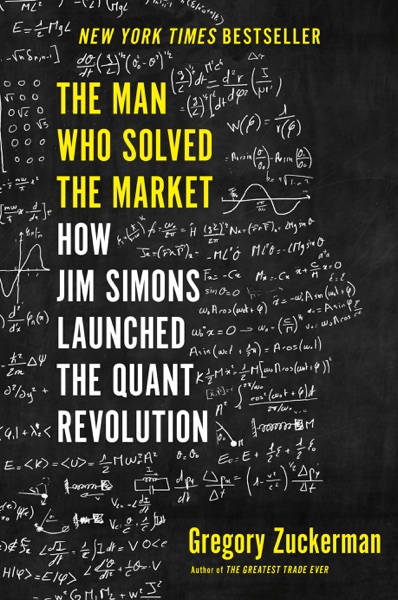
The Man Who Solved the Market is Gregory Zuckerman's account of Jim Simons, the mathematician who founded Renaissance Technologies and built the most successful investment firm in history.
Gregory Zuckerman · 2019 · 6h 15m
Full summary and key takeaways →The 12 questions
- 1.
Renaissance's models find patterns without requiring explanations for why they exist. What does that tell us about the nature of financial markets, and what are the limits of that approach?
- 2.
Simons hired scientists specifically because they didn't think like economists. In what other fields might importing outsiders with different training produce similar advantages?
- 3.
The Medallion Fund's returns are so far above any competitor that they are hard to explain even within Renaissance. What does persistent outperformance at this level suggest about market efficiency?
- 4.
Zuckerman traces how Mercer's wealth flowed into political causes that Simons opposed. Does accumulating wealth through a mathematical process carry any moral responsibility for what the wealth funds?
- 5.
Renaissance employees signed remarkably restrictive NDAs and the firm maintained extraordinary secrecy. Is that secrecy legitimate intellectual property protection or something that crosses a line?
- 6.
The book chronicles recurring internal conflicts between systematic and fundamental approaches. Where in your own work do you see analogous debates between data-driven and intuition-driven decision-making?
- 7.
The Medallion Fund is closed to outside investors and only available to Renaissance employees. If you accept the fund's returns as real, is that arrangement defensible?
- 8.
Simons moved from mathematics to codebreaking to business before finding finance. What does his career suggest about the relationship between deep expertise in one domain and the ability to generate new insights in another?
- 9.
Zuckerman got remarkable access for a book about one of the most secretive firms in the world. How do you assess the reliability of a business biography built largely on retrospective interviews with insiders?
- 10.
The book ends with questions about political consequence but doesn't fully resolve them. What do you think the obligations of major political donors are when their money goes to causes that harm others?
- 11.
Renaissance employees made enormous sums but lived under severe restrictions on what they could do professionally after leaving. Is that a reasonable trade?
- 12.
If you were designing a quantitative trading firm today, which of Simons' organizational choices would you replicate and which would you change?
How to run the discussion
- Pick six to eight, not all of them. An hour of real discussion covers fewer questions than anyone expects, and racing the list is what makes a book club feel like homework.
- Open with what people noticed, not what they concluded. Asking for a verdict first hardens opinions before anyone has heard each other.
- Let the disagreement run. The questions below that split a room are the ones worth the time; the ones everyone answers the same way can be skipped.
- Ask the quiet person a specific question. A direct, narrow question is far easier to answer than an open invitation to contribute.
Themes worth steering toward
If the conversation stalls, these are the threads that usually restart it.
Common questions
What are good book club questions for The Man Who Solved the Market?
Here are 12 book club questions for The Man Who Solved the Market by Gregory Zuckerman, ordered to open easily and end somewhere worth arguing about. The strongest openers ask what each reader noticed rather than what they concluded, and the discussion usually turns on quantitative finance, financial markets, mathematics and science.
How long should a book club discussion of The Man Who Solved the Market last?
Most groups run 60 to 90 minutes of actual discussion. That is roughly six to eight questions, not all of them, so pick the ones that suit your group rather than working down the list in order.
What are the main themes in The Man Who Solved the Market?
Quantitative finance, Financial markets, Mathematics and science, Wealth, Secretive organizations. Those are the threads most likely to divide a room, which makes them the useful places to steer a discussion that has gone quiet.
Picking the next one? See books like The Man Who Solved the Market or questions for other book club picks.
