Business · Book club
The Management Myth book club questions
Here are 12 book club questions for The Management Myth by Matthew Stewart, ordered to open easily and end somewhere worth arguing about. Copy them, print them, or bring them up one at a time.
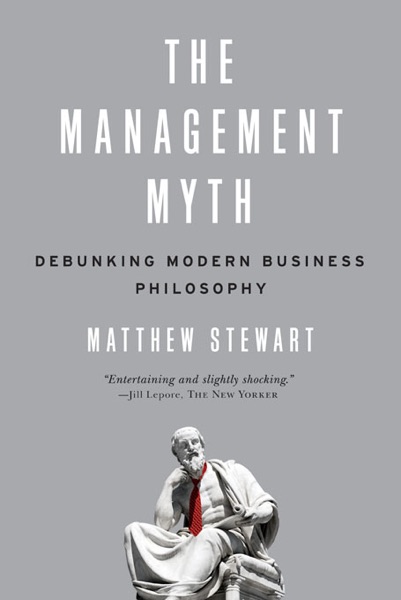
Matthew Stewart spent several years as a management consultant at a prestigious firm before concluding that much of what he was selling was not knowledge but the performance of knowledge.
Matthew Stewart · 2009 · 5h 0m
Full summary and key takeaways →The 12 questions
- 1.
Stewart argues that Taylor's foundational studies were fraudulent. If that's true, how much of modern management practice should be reconsidered from scratch?
- 2.
He describes selling management advice he'd constructed that week as legitimate expertise. Where in your own professional life have you seen similar performances of knowledge?
- 3.
The book claims philosophy prepares people better for management than MBAs. Do you believe that? What would it actually take to test the claim?
- 4.
Taylor's model separates the people who think about work from the people who do it. Where in your organization is that separation present, and what does it cost?
- 5.
Stewart is hard on consulting firms but acknowledges they fill a real need. What legitimate value does management consulting provide, and what is theater?
- 6.
He traces a direct line from Taylor's scientific management to modern process optimization. What is the most Taylorist practice you encounter regularly in your own organization?
- 7.
The book argues that management is best understood as a craft learned through practice, not a discipline of transferable knowledge. What implications does that have for how you'd train managers?
- 8.
Stewart left consulting to write philosophy. What would it take for you to leave your current career for something that felt more honest?
- 9.
He notes that organizations consistently prefer the appearance of rational management to the reality of messy judgment. Why do organizations so badly want to believe that management is a science?
- 10.
The most effective leaders Stewart encountered operated through personal presence and relationship rather than frameworks. Can that kind of leadership be developed deliberately?
- 11.
Management theory has been remarkably resilient to empirical challenge. Why do frameworks persist after the evidence turns against them?
- 12.
If you were designing a management education program from scratch, knowing what Stewart describes, what would it include and what would you cut?
How to run the discussion
- Pick six to eight, not all of them. An hour of real discussion covers fewer questions than anyone expects, and racing the list is what makes a book club feel like homework.
- Open with what people noticed, not what they concluded. Asking for a verdict first hardens opinions before anyone has heard each other.
- Let the disagreement run. The questions below that split a room are the ones worth the time; the ones everyone answers the same way can be skipped.
- Ask the quiet person a specific question. A direct, narrow question is far easier to answer than an open invitation to contribute.
Themes worth steering toward
If the conversation stalls, these are the threads that usually restart it.
Common questions
What are good book club questions for The Management Myth?
Here are 12 book club questions for The Management Myth by Matthew Stewart, ordered to open easily and end somewhere worth arguing about. The strongest openers ask what each reader noticed rather than what they concluded, and the discussion usually turns on management, consulting, organizational theory.
How long should a book club discussion of The Management Myth last?
Most groups run 60 to 90 minutes of actual discussion. That is roughly six to eight questions, not all of them, so pick the ones that suit your group rather than working down the list in order.
What are the main themes in The Management Myth?
Management, Consulting, Organizational theory, Critique, Philosophy. Those are the threads most likely to divide a room, which makes them the useful places to steer a discussion that has gone quiet.
Picking the next one? See books like The Management Myth or questions for other book club picks.
