Self-help · Book club
The Memory Book book club questions
Here are 11 book club questions for The Memory Book by Harry Lorayne and Jerry Lucas, ordered to open easily and end somewhere worth arguing about. Copy them, print them, or bring them up one at a time.
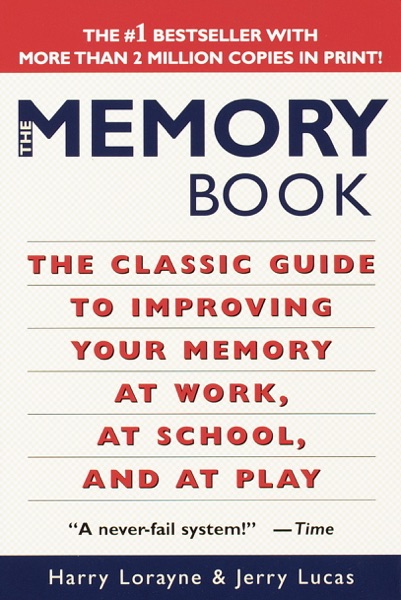
The Memory Book is Harry Lorayne and Jerry Lucas's classic guide to memory improvement, first published in 1974 and still in print over fifty years later.
Harry Lorayne and Jerry Lucas · 1974 · 3h 45m
Full summary and key takeaways →The 11 questions
- 1.
Have you ever used a mnemonic to remember something — a rhyme, a story, an image? How did it work compared to rote repetition?
- 2.
The book argues that memory failure is usually attention failure. When you forget a name you were just told, what do you think is actually happening?
- 3.
Try the link system on a list of ten items. Did creating the images feel effortful, and did the images actually help you remember the sequence?
- 4.
Why do you think memory techniques like these aren't taught in schools, given the evidence that they work?
- 5.
Lorayne and Lucas say that original awareness — truly noticing something at the moment of encounter — is the foundation of memory. How often are you genuinely attending when you meet someone new?
- 6.
The substitute word technique requires finding concrete soundalikes for abstract words. What does this reveal about how language and memory interact?
- 7.
The method of loci is thousands of years old and still used by memory champions. Why do you think spatial memory is so much stronger than verbal memory?
- 8.
If you memorized the names of everyone at a gathering the way Lorayne does, how would that change your experience of the event?
- 9.
What's the most practically useful application of these techniques for your specific life? Names? Numbers? Presentations?
- 10.
Memory champions who compete in events like the World Memory Championships use these exact techniques. Does knowing that people can memorize a shuffled deck of cards in under a minute change how you think about your own memory capacity?
- 11.
The book was written in 1974. What has changed in how we think about memory since then, and what remains the same?
How to run the discussion
- Pick six to eight, not all of them. An hour of real discussion covers fewer questions than anyone expects, and racing the list is what makes a book club feel like homework.
- Open with what people noticed, not what they concluded. Asking for a verdict first hardens opinions before anyone has heard each other.
- Let the disagreement run. The questions below that split a room are the ones worth the time; the ones everyone answers the same way can be skipped.
- Ask the quiet person a specific question. A direct, narrow question is far easier to answer than an open invitation to contribute.
Themes worth steering toward
If the conversation stalls, these are the threads that usually restart it.
Common questions
What are good book club questions for The Memory Book?
Here are 11 book club questions for The Memory Book by Harry Lorayne and Jerry Lucas, ordered to open easily and end somewhere worth arguing about. The strongest openers ask what each reader noticed rather than what they concluded, and the discussion usually turns on memory, mnemonics, learning.
How long should a book club discussion of The Memory Book last?
Most groups run 60 to 90 minutes of actual discussion. That is roughly six to eight questions, not all of them, so pick the ones that suit your group rather than working down the list in order.
What are the main themes in The Memory Book?
Memory, Mnemonics, Learning, Recall, Mental techniques. Those are the threads most likely to divide a room, which makes them the useful places to steer a discussion that has gone quiet.
Picking the next one? See books like The Memory Book or questions for other book club picks.
