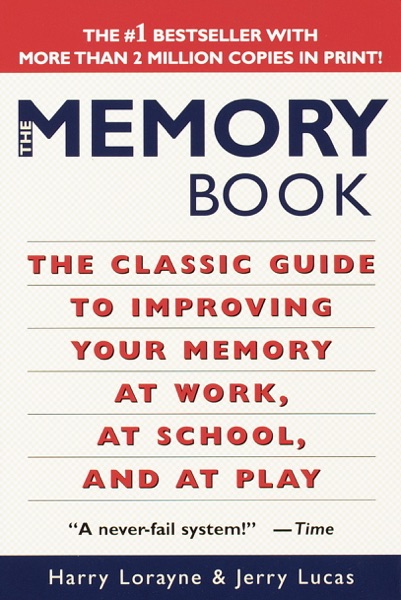
The Memory Book by Harry Lorayne and Jerry Lucas is a 1974 self-help book about memory, mnemonics, learning. Memory is not a passive ability you're born with — it's a skill built through active association. The single most important principle is that anything can be remembered if you force yourself to make an absurd, vivid connection to it.
Summary
The Memory Book is Harry Lorayne and Jerry Lucas's classic guide to memory improvement, first published in 1974 and still in print over fifty years later. Lorayne was a professional memory entertainer who could memorize the names of every audience member in a theater; Lucas was an NBA star who memorized entire phone books for entertainment. Together they distilled the techniques of memory champions into a practical system for ordinary people.
The book's foundation is the link system and the substitute word technique. The link system connects items in a sequence through vivid, absurd, and action-filled mental images — the more outrageous the connection, the better it encodes. The substitute word technique handles abstract or unfamiliar words by finding a concrete soundalike and building an image from it. These two systems are simple enough to explain in a chapter but require practice to make automatic. Lorayne and Lucas are honest about this: the techniques work, but they require effort to apply initially.
The second major system is the peg system, which assigns a consonant sound to each digit from zero to nine and then builds words from those consonants. Numbers that are otherwise almost impossible to remember become words, and words can be visualized. By the time the book covers the method of loci — placing vivid images along a familiar mental route — readers have the vocabulary to understand how the ancient technique actually works rather than just being told it exists.
What makes the book distinctive is the breadth of application. Lorayne and Lucas cover memorizing names and faces (arguably the most practically useful section), speeches and presentations, playing cards, foreign vocabulary, grocery lists, and phone numbers. Each application follows the same underlying logic, which makes the system feel unified rather than a collection of tricks. The writing is conversational and the exercises are embedded throughout. For readers willing to actually do the work, it delivers on its promises more reliably than most memory books.
Talk to The Memory Book like its author wrote you back.
Get the ideas that fit your life — not generic summaries.
- Chat with the book
- Audiobook-style main ideas
- Adapts to your life and goals
- Helps you take action
Key takeaways
- 1.
Memory is not a passive ability you're born with — it's a skill built through active association. The single most important principle is that anything can be remembered if you force yourself to make an absurd, vivid connection to it.
- 2.
The link system works by creating a chain of ridiculous mental images. Each image connects to the next through an impossible action or visual. The stranger the image, the better it encodes.
- 3.
The peg system converts numbers to sounds and sounds to words. Numbers become concrete objects that can be visualized and associated with anything, making long sequences of digits memorable.
- 4.
The substitute word technique handles unfamiliar words by finding a phonetic soundalike that is concrete enough to visualize. Abstract concepts become tangible images.
- 5.
Memorizing names and faces requires the same techniques applied specifically: find a substitute word for the name, find a distinctive feature on the face, and build an absurd image connecting the two.
- 6.
The method of loci places items to be remembered along a familiar mental route. It is the oldest memory technique in recorded history, and it works because spatial memory is one of the strongest we have.
- 7.
Interest and attention are the prerequisites for memory. You cannot remember something you never properly noticed in the first place. The techniques work by forcing genuine attention at the moment of encoding.
Discussion questions
Use these on your own, with a book club, or as chat starters in Superbook. Book club version, ready to copy or print →
- 1.
Have you ever used a mnemonic to remember something — a rhyme, a story, an image? How did it work compared to rote repetition?
- 2.
The book argues that memory failure is usually attention failure. When you forget a name you were just told, what do you think is actually happening?
- 3.
Try the link system on a list of ten items. Did creating the images feel effortful, and did the images actually help you remember the sequence?
- 4.
Why do you think memory techniques like these aren't taught in schools, given the evidence that they work?
- 5.
Lorayne and Lucas say that original awareness — truly noticing something at the moment of encounter — is the foundation of memory. How often are you genuinely attending when you meet someone new?
- 6.
The substitute word technique requires finding concrete soundalikes for abstract words. What does this reveal about how language and memory interact?
- 7.
The method of loci is thousands of years old and still used by memory champions. Why do you think spatial memory is so much stronger than verbal memory?
- 8.
If you memorized the names of everyone at a gathering the way Lorayne does, how would that change your experience of the event?
- 9.
What's the most practically useful application of these techniques for your specific life? Names? Numbers? Presentations?
- 10.
Memory champions who compete in events like the World Memory Championships use these exact techniques. Does knowing that people can memorize a shuffled deck of cards in under a minute change how you think about your own memory capacity?
- 11.
The book was written in 1974. What has changed in how we think about memory since then, and what remains the same?
Themes
Frequently asked questions
-
Is The Memory Book still relevant today?
Yes. The core techniques — the link system, the peg system, the method of loci — are still the foundation of competitive memory sport and accelerated learning. The specific framing is dated, but the methods are as effective now as they were in 1974. Most subsequent memory books draw heavily from this one.
-
How long does it take to read The Memory Book?
About three to four hours to read through. The techniques require additional practice time to make them automatic. Many readers work through the exercises over a week or two rather than reading straight through.
-
What is the most practically useful section of The Memory Book?
The names and faces chapter is most immediately applicable for most readers. Forgetting names is near-universal and has real social costs. The technique in the book — substitute words combined with a distinctive facial feature — can be applied immediately and produces visible results quickly.
-
Do I have to do the exercises to get value from The Memory Book?
Yes. Reading about the techniques without practicing them produces almost no benefit. The authors make this explicit throughout. The exercises are not optional extras — they're the point.
-
Who should read The Memory Book?
Anyone who struggles with names, numbers, or retaining new information professionally. Also useful for students learning large amounts of structured material and professionals who give presentations without notes.