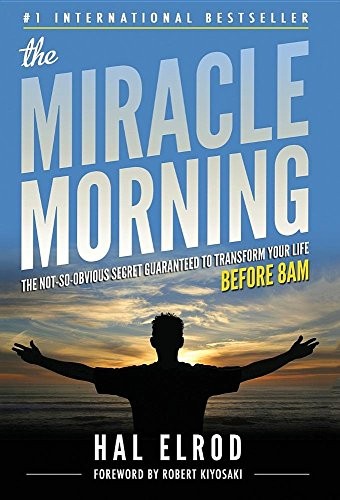
The Miracle Morning by Hal Elrod is a 2012 self-help book about morning routines, habits, personal development. The first hour of the day sets the tone for everything that follows. Designing it intentionally rather than reacting to external demands creates compounding positive effects over time.
Summary
The Miracle Morning is Hal Elrod's account of how a structured early-morning routine transformed his life after a near-fatal car accident left him with brain damage at age twenty, and subsequently saved him from near-bankruptcy during the 2008 financial crisis. His core argument is that how you spend the first hour of your day disproportionately determines the quality of the rest of it — and that most people squander this leverage by starting reactively.
The practical framework is the SAVERS: six morning practices Elrod claims address every dimension of personal development. Silence (meditation or stillness). Affirmations (written positive statements about desired future states). Visualization (mentally experiencing your goals achieved). Exercise (any physical movement). Reading (something educational or inspiring). Scribing (journaling, which Elrod's spelling accommodates for the acronym). Each practice is brief — the original claim is that sixty minutes covers all six — and Elrod offers variations for people with less time.
The book's backstory is central to its persuasiveness: Elrod describes waking up in a hospital with permanent brain damage after being hit by a drunk driver, being told he would never walk normally again, and subsequently running ultramarathons. When the financial crisis destroyed his sales income, he turned to morning practices he'd learned from a mentor and experienced a rapid turnaround.
The Miracle Morning spawned a large community and numerous spin-off books for specific professional groups (salespeople, parents, entrepreneurs). As a framework it is more inspirational than rigorously evidence-based — the affirmations and visualization components in particular lack the research support of the mindfulness and exercise components. But as a practical starter routine for people who currently start their days without any intentional structure, it provides a coherent scaffold.
Talk to The Miracle Morning like its author wrote you back.
Get the ideas that fit your life — not generic summaries.
- Chat with the book
- Audiobook-style main ideas
- Adapts to your life and goals
- Helps you take action
Key takeaways
- 1.
The first hour of the day sets the tone for everything that follows. Designing it intentionally rather than reacting to external demands creates compounding positive effects over time.
- 2.
The SAVERS framework — Silence, Affirmations, Visualization, Exercise, Reading, Scribing — addresses mental, physical, and motivational dimensions of development in a single daily block.
- 3.
Starting small is better than starting never. A six-minute Miracle Morning, with one minute per SAVERS practice, is available to anyone regardless of schedule.
- 4.
Waking up is a psychological event as much as a physical one. How you think about your alarm determines your energy level when you get up. Reframing the alarm as a positive prompt changes the experience.
- 5.
Affirmations work best when they describe the person you are becoming and the actions required, not just the outcomes desired. Passive affirmations produce less change than action-oriented ones.
- 6.
Journaling ('scribing') makes your thinking visible. Writing about your goals, challenges, and feelings regularly produces clarity that mental processing alone rarely achieves.
- 7.
Personal development accumulates. Investing even thirty minutes per day in deliberate self-improvement — reading, reflection, physical health — compounds into large differences over a year.
- 8.
Many people are living far below their potential not because of lack of ability but because of absence of intentional daily practice. The morning routine creates the structure for that practice.
Discussion questions
Use these on your own, with a book club, or as chat starters in Superbook. Book club version, ready to copy or print →
- 1.
What does your current morning look like? Is it designed intentionally or does it happen to you?
- 2.
Which of the SAVERS six practices is most absent from your current life? Which would have the highest impact if you added it consistently?
- 3.
Elrod's backstory — recovering from brain damage, then from financial collapse — is central to the book's persuasiveness. Does the personal testimony make the framework more or less credible to you?
- 4.
The affirmations and visualization practices lack strong research support compared to mindfulness and exercise. Does that change how you think about including them in a routine?
- 5.
He claims you can do a Miracle Morning in six minutes if necessary. What would an honest six-minute version look like for you? Could you actually start tomorrow?
- 6.
What would need to change about your evenings or sleep schedule to make an intentional morning routine sustainable?
- 7.
Journaling is one of the six practices. If you've tried journaling and stopped, what specific obstacle ended the habit? What would a more sustainable version look like?
- 8.
The book argues that most mediocrity comes from absence of intentional practice rather than lack of talent. Do you agree with that premise in your own experience?
- 9.
Elrod describes his community of Miracle Morning practitioners as a significant support structure. How important is community to habit change in your experience?
- 10.
What single thirty-minute morning practice, if you did it consistently for ninety days, would most change an area of your life you want to improve?
- 11.
What's the honest version of what prevents you from starting your days more intentionally? Is it structural (schedule, children, commute) or psychological?
Themes
Frequently asked questions
-
Is The Miracle Morning worth reading?
It depends on where you are. If you have no morning routine and want a practical starter framework, it's useful and inspiring. If you already have structured mornings, much of the book will feel familiar. The SAVERS framework is a reasonable structure; the research support behind individual practices varies.
-
How long does it take to read The Miracle Morning?
About three hours. It is shorter and lighter than most personal development books. The core framework is introduced in the first half; the second half covers implementation and variations.
-
What is the SAVERS framework?
Silence, Affirmations, Visualization, Exercise, Reading, Scribing. Elrod designed it to cover mental clarity, motivation, physical health, learning, and reflection in a single daily block. The practices can be scaled from six minutes to an hour.
-
Is the evidence behind the Miracle Morning strong?
Mixed. Exercise, meditation, and journaling have solid research support. Affirmations and visualization are more contested — the evidence base is weaker and some research suggests they can backfire. The framework's real value is structural: it provides a reason to show up for self-improvement daily.
-
Who should read The Miracle Morning?
People who currently start their days reactively and want a practical, accessible framework for building intentional morning habits. Also useful for people who know what habits they want to build but haven't found a way to anchor them to a consistent daily structure.