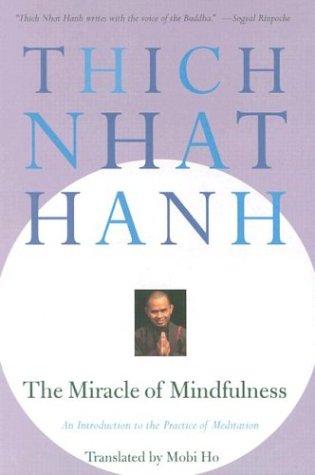
Talk to The Miracle of Mindfulness like its author wrote you back.
Get the ideas that fit your life — not generic summaries.
- Chat with the book
- Audiobook-style main ideas
- Adapts to your life and goals
- Helps you take action
The Miracle of Mindfulness, in detail
The Miracle of Mindfulness is Thich Nhat Hanh's introduction to mindfulness practice, originally written in Vietnamese as a letter to a fellow monk. The English translation, published in 1975, became one of the most widely read introductions to Buddhist meditation in the West. Hanh's central claim is deceptively simple: that mindfulness — the practice of remaining fully present in each moment — is not a technique to apply during a dedicated meditation session but a quality of attention that can permeate every activity of daily life.
The book uses ordinary tasks as its teaching ground: washing dishes, peeling a tangerine, drinking tea, taking a walk. Hanh argues that the mistake most people make is to treat these activities as obstacles separating them from something more important. When washing dishes, most minds are already in the future — planning, rehearsing, worrying. Hanh's instruction is to wash dishes in order to wash dishes, not in order to have clean dishes. The present moment is not a means to an end; it is the only place where life actually occurs.
The meditation practices Hanh describes are accessible and precise. He gives instructions for following the breath, for walking meditation, for body scanning, and for a technique he calls the half-smile — a subtle physical cue that can shift the quality of attention. He is careful to explain the relationship between mindfulness and concentration, and why sustained practice produces insight that sporadic effort does not. The teaching on interdependence — the way each thing contains all other things — is introduced gently, without the density of formal philosophical argument.
What distinguishes the book from more methodological meditation guides is the tenderness of the voice. Hanh writes like someone sitting next to you rather than instructing from a distance, and the tone is one of genuine affection for the difficulty of maintaining attention in an ordinary life full of obligations and distractions. The book is short and can be read in an afternoon, but its central practice is one that practitioners return to over years. For anyone seeking an accessible, non-dogmatic introduction to mindfulness rooted in Buddhist tradition, this remains a foundational text.
The big ideas
- 1.
Mindfulness is not limited to formal meditation. It can be practiced in any activity — eating, walking, washing dishes — if the activity receives full, undivided attention.
- 2.
The present moment is the only location where life happens. Most mental suffering arises from dwelling in the past or projecting into the future.
- 3.
Breathing is the most accessible anchor for attention. Conscious attention to the breath can return scattered awareness to the present at any moment.
