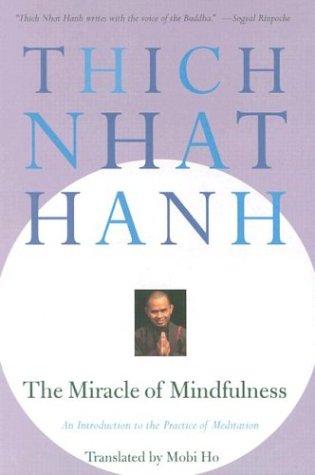
The Miracle of Mindfulness by Thich Nhat Hanh is a 1975 religion & spirituality book about mindfulness, meditation, present moment. Mindfulness is not limited to formal meditation. It can be practiced in any activity — eating, walking, washing dishes — if the activity receives full, undivided attention.
Summary
The Miracle of Mindfulness is Thich Nhat Hanh's introduction to mindfulness practice, originally written in Vietnamese as a letter to a fellow monk. The English translation, published in 1975, became one of the most widely read introductions to Buddhist meditation in the West. Hanh's central claim is deceptively simple: that mindfulness — the practice of remaining fully present in each moment — is not a technique to apply during a dedicated meditation session but a quality of attention that can permeate every activity of daily life.
The book uses ordinary tasks as its teaching ground: washing dishes, peeling a tangerine, drinking tea, taking a walk. Hanh argues that the mistake most people make is to treat these activities as obstacles separating them from something more important. When washing dishes, most minds are already in the future — planning, rehearsing, worrying. Hanh's instruction is to wash dishes in order to wash dishes, not in order to have clean dishes. The present moment is not a means to an end; it is the only place where life actually occurs.
The meditation practices Hanh describes are accessible and precise. He gives instructions for following the breath, for walking meditation, for body scanning, and for a technique he calls the half-smile — a subtle physical cue that can shift the quality of attention. He is careful to explain the relationship between mindfulness and concentration, and why sustained practice produces insight that sporadic effort does not. The teaching on interdependence — the way each thing contains all other things — is introduced gently, without the density of formal philosophical argument.
What distinguishes the book from more methodological meditation guides is the tenderness of the voice. Hanh writes like someone sitting next to you rather than instructing from a distance, and the tone is one of genuine affection for the difficulty of maintaining attention in an ordinary life full of obligations and distractions. The book is short and can be read in an afternoon, but its central practice is one that practitioners return to over years. For anyone seeking an accessible, non-dogmatic introduction to mindfulness rooted in Buddhist tradition, this remains a foundational text.
Talk to The Miracle of Mindfulness like its author wrote you back.
Get the ideas that fit your life — not generic summaries.
- Chat with the book
- Audiobook-style main ideas
- Adapts to your life and goals
- Helps you take action
Key takeaways
- 1.
Mindfulness is not limited to formal meditation. It can be practiced in any activity — eating, walking, washing dishes — if the activity receives full, undivided attention.
- 2.
The present moment is the only location where life happens. Most mental suffering arises from dwelling in the past or projecting into the future.
- 3.
Breathing is the most accessible anchor for attention. Conscious attention to the breath can return scattered awareness to the present at any moment.
- 4.
Washing dishes in order to wash dishes — not to get to the next thing — is Hanh's emblematic instruction. The quality of attention applied to small tasks transforms them.
- 5.
Mindfulness and concentration are distinct but related. Mindfulness is awareness of what is present; concentration is the sustained application of that awareness without distraction.
- 6.
The half-smile is a physical practice: a slight relaxation of the face that can shift the quality of inner attention and soften reactivity.
- 7.
Mindfulness must be practiced consistently to develop. Brief daily practice builds a different quality of attention than occasional longer sessions.
- 8.
Interdependence — the way each moment contains all other moments, each thing contains all other things — is not only a philosophical idea but something that can be directly experienced through mindfulness.
Discussion questions
Use these on your own, with a book club, or as chat starters in Superbook. Book club version, ready to copy or print →
- 1.
Hanh argues that mindfulness can be practiced in any activity, not just formal meditation. Is that a broadening of the practice or a dilution of it?
- 2.
Think of a routine task you do daily. What would it feel like to give it your full, undivided attention without rushing through it? Have you ever experienced that?
- 3.
Hanh says most mental suffering comes from living in the past or future rather than the present. Does that claim match your own experience? Where are the exceptions?
- 4.
The book was written as a letter to a fellow monk. Does reading it in that context — intimate instruction rather than published manual — change how you receive it?
- 5.
What is the relationship between mindfulness as Hanh describes it and modern secular mindfulness practices like those in MBSR programs? What gets translated, and what gets lost?
- 6.
Hanh treats ordinary daily tasks as opportunities for practice rather than interruptions to it. What would have to change about your relationship to your schedule for that to feel true?
- 7.
The concept of interdependence appears throughout the book. How does Hanh introduce it, and does it land as philosophy, experience, or something else?
- 8.
The half-smile is described as a physical practice that shifts inner states. Are you skeptical of that claim? Have you experienced anything similar with physical posture or gesture?
- 9.
Hanh's voice is notably gentle and non-prescriptive. Is that an effective way to teach difficult practices, or does it leave readers without clear enough instruction?
- 10.
The book is short and can be read quickly. Does reading it slowly and practicing alongside it produce a different experience than reading it straight through?
- 11.
Hanh writes that mindfulness is available to everyone regardless of religion or tradition. How Buddhist is this book, really, and does that matter for how it should be read?
Themes
Frequently asked questions
-
Is The Miracle of Mindfulness worth reading?
Yes, especially for anyone new to mindfulness or looking for an accessible introduction rooted in Buddhist tradition. It is short, warm, and precise. Experienced meditators will find it useful as a return to fundamentals rather than a source of new technique.
-
How long does it take to read?
Around two hours. At roughly 150 pages it is one of the shortest serious books on meditation, but many readers return to it multiple times. It rewards slow reading with practice alongside it more than quick reading.
-
What is the main idea of The Miracle of Mindfulness?
That full, attentive presence in each moment — regardless of what that moment contains — is both the practice and the goal. Mindfulness is not a technique to apply but a quality of awareness to cultivate throughout all activities.
-
How does this book differ from secular mindfulness programs?
Hanh writes from within the Zen Buddhist tradition, and concepts like interdependence and the nature of the self appear alongside the practical instruction. Secular programs strip those elements. The book is closer to the original source and carries a different register — quieter and more philosophical.
-
Who should read this book?
Anyone beginning a meditation practice, anyone who has felt that mindfulness feels contrived or effortful, and readers curious about Buddhist approaches to attention that are not heavily doctrinal. It is also a good companion to more technique-heavy books that lack the contemplative depth Hanh brings.