Science · Book club
The Molecule of More book club questions
Here are 12 book club questions for The Molecule of More by Daniel Z. Lieberman & Michael E. Long, ordered to open easily and end somewhere worth arguing about. Copy them, print them, or bring them up one at a time.
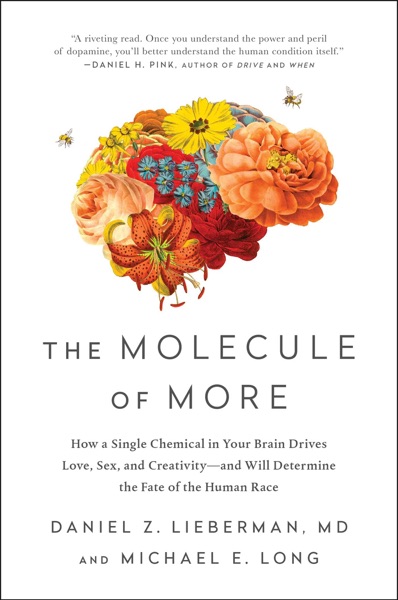
The Molecule of More is psychiatrist Daniel Lieberman and writer Michael E.
Daniel Z. Lieberman & Michael E. Long · 2018 · 4h 40m
Full summary and key takeaways →The 12 questions
- 1.
The book argues that dopamine drives desire but not satisfaction. Reflecting on your own experience, where do you find the wanting-having gap most pronounced?
- 2.
Lieberman frames dopamine as the molecule of 'more' — perpetually unsatisfied. Is that characterization supported by your own relationship to goals and achievement?
- 3.
The book's political neuroscience — that dopamine correlates with progressive thinking and serotonin/oxytocin with conservative thinking — is probably its most contested claim. Do you find that framing useful or reductive?
- 4.
Addiction is described as a hijacking of the dopamine prediction-error system. Does that framing change how you think about addictive behaviors, whether in yourself or others?
- 5.
The book distinguishes between the dopamine system (desire, future, novelty) and the H&N system (satisfaction, present, familiarity). How does your daily environment favor or suppress each?
- 6.
The creativity chapter links dopamine to both artistic genius and psychiatric vulnerability. What do you make of the claim that the same circuitry mediates both?
- 7.
Lieberman argues that romantic love transitions from dopamine-driven to H&N-driven over time. Does that framing capture your experience of long-term relationships?
- 8.
If the dopamine system fires strongest at unexpected rewards, what does that imply about how to structure goal-setting and reward systems in organizations?
- 9.
The book suggests that modern media and technology are particularly good at exploiting dopamine — through variable reward schedules, novelty, and FOMO. How does this frame your relationship to your phone?
- 10.
The H&N system — serotonin, oxytocin, endorphins — operates in the present and through physical and social connection. What practices in your own life most reliably engage it?
- 11.
Lieberman suggests that high-dopamine, future-oriented thinking is good for civilization-building but bad for personal happiness. How do you reconcile ambition with present-moment satisfaction?
- 12.
The book is written for a general audience and simplifies complex neuroscience. Where do you find the simplification useful, and where does it leave you wanting more precision?
How to run the discussion
- Pick six to eight, not all of them. An hour of real discussion covers fewer questions than anyone expects, and racing the list is what makes a book club feel like homework.
- Open with what people noticed, not what they concluded. Asking for a verdict first hardens opinions before anyone has heard each other.
- Let the disagreement run. The questions below that split a room are the ones worth the time; the ones everyone answers the same way can be skipped.
- Ask the quiet person a specific question. A direct, narrow question is far easier to answer than an open invitation to contribute.
Themes worth steering toward
If the conversation stalls, these are the threads that usually restart it.
Common questions
What are good book club questions for The Molecule of More?
Here are 12 book club questions for The Molecule of More by Daniel Z. Lieberman & Michael E. Long, ordered to open easily and end somewhere worth arguing about. The strongest openers ask what each reader noticed rather than what they concluded, and the discussion usually turns on dopamine, desire, motivation.
How long should a book club discussion of The Molecule of More last?
Most groups run 60 to 90 minutes of actual discussion. That is roughly six to eight questions, not all of them, so pick the ones that suit your group rather than working down the list in order.
What are the main themes in The Molecule of More?
Dopamine, Desire, Motivation, Addiction, Human behavior. Those are the threads most likely to divide a room, which makes them the useful places to steer a discussion that has gone quiet.
Picking the next one? See books like The Molecule of More or questions for other book club picks.
