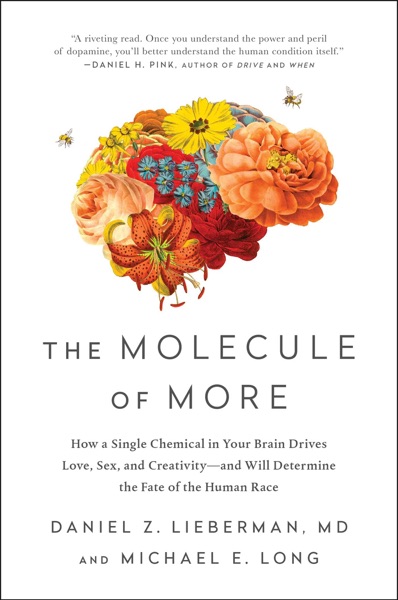
The Molecule of More by Daniel Z. Lieberman & Michael E. Long is a 2018 science book about dopamine, desire, motivation. Dopamine is the desire chemical, not the pleasure chemical. It fires in anticipation of reward and quiets once reward is obtained. The system drives wanting, not having.
Summary
The Molecule of More is psychiatrist Daniel Lieberman and writer Michael E. Long's account of how dopamine — a single neurotransmitter — shapes human desire, creativity, addiction, politics, and love. The book's central argument is that dopamine is not the pleasure chemical, as it is commonly described. It is the desire chemical — the system that drives us to pursue what we do not yet have. Once something is possessed or familiar, dopamine steps back and a different set of chemicals (serotonin, oxytocin, endorphins) takes over. This distinction between wanting and having is the book's organizing insight and explains a surprisingly large range of human behavior.
The dopamine system, Lieberman argues, evolved to help us pursue resources in an uncertain environment. It fires in response to the unexpected and quiets when expectations are met. This produces a characteristic asymmetry: we are motivated more intensely by the prospect of getting something than by the experience of having it. This is why romantic attraction fades after the chase, why addicts find the first high impossible to replicate, and why ambitious people never feel they have accomplished enough. The system is not a flaw — it is the engine of exploration, creativity, and long-range planning. But it runs on a grammar of scarcity and novelty that modern environments exploit relentlessly.
The book covers dopamine's role in creativity (the same divergent, future-oriented thinking that produces innovative ideas also produces loose associations characteristic of certain psychiatric conditions), in politics (Lieberman argues that dopamine-dominant thinking correlates with progressive orientation, while serotonin and oxytocin systems correlate with conservative or traditional orientation), in love (the transition from dopamine-driven early attraction to H&N-driven attachment), and in addiction (where the dopamine system is hijacked by substances that produce artificially large prediction-error signals).
The writing is accessible and example-rich, aimed at a general audience rather than a specialist one. Some of the political claims have attracted criticism as oversimplified, and the neuroscience is necessarily popular rather than technical. But as an introduction to the idea that a single molecule mediates the gap between what we have and what we want — and that this gap is central to human psychology — the book is clear and thought-provoking. Readers who finish it will find the framework appearing in their own behavior for weeks afterward.
Talk to The Molecule of More like its author wrote you back.
Get the ideas that fit your life — not generic summaries.
- Chat with the book
- Audiobook-style main ideas
- Adapts to your life and goals
- Helps you take action
Key takeaways
- 1.
Dopamine is the desire chemical, not the pleasure chemical. It fires in anticipation of reward and quiets once reward is obtained. The system drives wanting, not having.
- 2.
Unexpected rewards produce the strongest dopamine response. Once an outcome is predictable, dopamine activity decreases. Novelty is fuel for the system.
- 3.
The dopamine system is future-oriented and abstract. It allows humans to plan, imagine, and pursue goals that exist only as possibilities. This is its evolutionary gift.
- 4.
Addiction hijacks the dopamine system by producing artificially large prediction-error signals, making natural rewards feel pale by comparison.
- 5.
The gap between early romantic attraction (dopamine-driven, intense, future-oriented) and long-term attachment (H&N-driven, present-focused, sustaining) explains why relationships change in character over time.
- 6.
Creativity and certain psychiatric conditions share a dopamine signature — loose associations, remote connections, divergent thinking. The same circuitry that enables innovation can, at higher intensities, produce pathology.
- 7.
Dopamine-dominant people tend toward exploration, risk-taking, and novelty-seeking. H&N-dominant people tend toward stability, tradition, and satisfaction in the present. Both systems are necessary and neither is superior.
- 8.
To improve wellbeing, Lieberman argues, means learning to engage the H&N system more deliberately — being present, building real relationships, and finding satisfaction in what you already have.
Discussion questions
Use these on your own, with a book club, or as chat starters in Superbook. Book club version, ready to copy or print →
- 1.
The book argues that dopamine drives desire but not satisfaction. Reflecting on your own experience, where do you find the wanting-having gap most pronounced?
- 2.
Lieberman frames dopamine as the molecule of 'more' — perpetually unsatisfied. Is that characterization supported by your own relationship to goals and achievement?
- 3.
The book's political neuroscience — that dopamine correlates with progressive thinking and serotonin/oxytocin with conservative thinking — is probably its most contested claim. Do you find that framing useful or reductive?
- 4.
Addiction is described as a hijacking of the dopamine prediction-error system. Does that framing change how you think about addictive behaviors, whether in yourself or others?
- 5.
The book distinguishes between the dopamine system (desire, future, novelty) and the H&N system (satisfaction, present, familiarity). How does your daily environment favor or suppress each?
- 6.
The creativity chapter links dopamine to both artistic genius and psychiatric vulnerability. What do you make of the claim that the same circuitry mediates both?
- 7.
Lieberman argues that romantic love transitions from dopamine-driven to H&N-driven over time. Does that framing capture your experience of long-term relationships?
- 8.
If the dopamine system fires strongest at unexpected rewards, what does that imply about how to structure goal-setting and reward systems in organizations?
- 9.
The book suggests that modern media and technology are particularly good at exploiting dopamine — through variable reward schedules, novelty, and FOMO. How does this frame your relationship to your phone?
- 10.
The H&N system — serotonin, oxytocin, endorphins — operates in the present and through physical and social connection. What practices in your own life most reliably engage it?
- 11.
Lieberman suggests that high-dopamine, future-oriented thinking is good for civilization-building but bad for personal happiness. How do you reconcile ambition with present-moment satisfaction?
- 12.
The book is written for a general audience and simplifies complex neuroscience. Where do you find the simplification useful, and where does it leave you wanting more precision?
Themes
Frequently asked questions
-
What is The Molecule of More about?
It's a popular science book about how dopamine — reframed as the desire chemical rather than the pleasure chemical — shapes ambition, addiction, creativity, love, and politics. The central insight is that dopamine fires for what we want, not for what we have.
-
Is The Molecule of More scientifically accurate?
The core neuroscience is sound and well-sourced. Some of the broader claims — particularly about political orientation mapping onto dopamine vs. serotonin/oxytocin systems — are more speculative and have been criticized as oversimplified. It is popular science, not a textbook.
-
Is this book useful for understanding addiction?
Yes. The prediction-error framework explains why addictive substances are so powerful (they produce artificially large dopamine signals) and why recovery is so hard (natural rewards feel dull by comparison). The explanation is clear and practically useful.
-
How is this different from Dopamine Nation by Anna Lembke?
Lembke's book focuses specifically on addiction and is more clinical and narrative-driven. The Molecule of More is broader, covering dopamine's role across all human motivation, creativity, and relationships. They complement each other well.
-
What is the most useful idea for daily life?
The distinction between the dopamine future-seeking system and the H&N present-satisfaction system. Recognizing that perpetual wanting is built into your neurology — not a character flaw — can shift how you approach goals, relationships, and the chronic dissatisfaction that achievement rarely resolves.
Similar books
Dopamine Nation: Finding Balance in the Age of Indulgence
Anna Lembke
Why We Sleep
Matthew Walker
The Willpower Instinct
Kelly McGonigal
Behave: The Biology of Humans at Our Best and Worst
Robert M. Sapolsky
The Molecule of More vs.
Deciding between two books? The Molecule of More vs Dopamine Nation .
