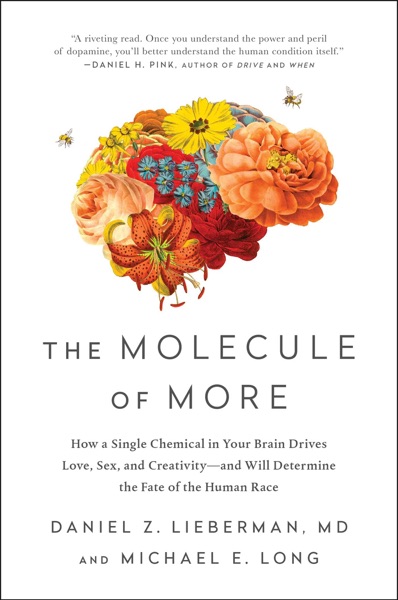
Talk to The Molecule of More like its author wrote you back.
Get the ideas that fit your life — not generic summaries.
- Chat with the book
- Audiobook-style main ideas
- Adapts to your life and goals
- Helps you take action
The Molecule of More, in detail
The Molecule of More is psychiatrist Daniel Lieberman and writer Michael E. Long's account of how dopamine — a single neurotransmitter — shapes human desire, creativity, addiction, politics, and love. The book's central argument is that dopamine is not the pleasure chemical, as it is commonly described. It is the desire chemical — the system that drives us to pursue what we do not yet have. Once something is possessed or familiar, dopamine steps back and a different set of chemicals (serotonin, oxytocin, endorphins) takes over. This distinction between wanting and having is the book's organizing insight and explains a surprisingly large range of human behavior.
The dopamine system, Lieberman argues, evolved to help us pursue resources in an uncertain environment. It fires in response to the unexpected and quiets when expectations are met. This produces a characteristic asymmetry: we are motivated more intensely by the prospect of getting something than by the experience of having it. This is why romantic attraction fades after the chase, why addicts find the first high impossible to replicate, and why ambitious people never feel they have accomplished enough. The system is not a flaw — it is the engine of exploration, creativity, and long-range planning. But it runs on a grammar of scarcity and novelty that modern environments exploit relentlessly.
The book covers dopamine's role in creativity (the same divergent, future-oriented thinking that produces innovative ideas also produces loose associations characteristic of certain psychiatric conditions), in politics (Lieberman argues that dopamine-dominant thinking correlates with progressive orientation, while serotonin and oxytocin systems correlate with conservative or traditional orientation), in love (the transition from dopamine-driven early attraction to H&N-driven attachment), and in addiction (where the dopamine system is hijacked by substances that produce artificially large prediction-error signals).
The writing is accessible and example-rich, aimed at a general audience rather than a specialist one. Some of the political claims have attracted criticism as oversimplified, and the neuroscience is necessarily popular rather than technical. But as an introduction to the idea that a single molecule mediates the gap between what we have and what we want — and that this gap is central to human psychology — the book is clear and thought-provoking. Readers who finish it will find the framework appearing in their own behavior for weeks afterward.
The big ideas
- 1.
Dopamine is the desire chemical, not the pleasure chemical. It fires in anticipation of reward and quiets once reward is obtained. The system drives wanting, not having.
- 2.
Unexpected rewards produce the strongest dopamine response. Once an outcome is predictable, dopamine activity decreases. Novelty is fuel for the system.
- 3.
The dopamine system is future-oriented and abstract. It allows humans to plan, imagine, and pursue goals that exist only as possibilities. This is its evolutionary gift.
