Economics · Book club
The Most Important Thing book club questions
Here are 12 book club questions for The Most Important Thing by Howard Marks, ordered to open easily and end somewhere worth arguing about. Copy them, print them, or bring them up one at a time.
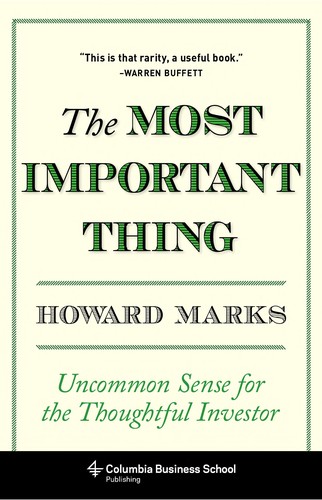
The Most Important Thing is Howard Marks's collection of investment insights drawn from his decades of memos to Oaktree Capital clients — memos that became famous in investment circles for their clarity, depth, and willingness to address the psychological dimensions of investing that most practitioners avoid.
Howard Marks · 2011 · 4h 45m
Full summary and key takeaways →The 12 questions
- 1.
Marks's 'second-level thinking' concept requires knowing what the consensus believes before you can identify where it might be wrong. For any investment you currently hold, what do you think the consensus view is?
- 2.
Marks distinguishes between risk and volatility. Does your own emotional and practical behavior during market declines suggest you experience them as the same thing?
- 3.
The risk-invisibility concept — that risk builds during good times — is counterintuitive enough that investors repeatedly fail to act on it. What conditions today suggest that risk is being accumulated somewhere in markets?
- 4.
Marks is explicit about what he doesn't know: he says reliable market direction prediction is impossible. Which financial commentators or analysts you follow are equally honest about the limits of their knowledge?
- 5.
The full-distribution-of-outcomes framework asks you to think about the scenarios in which an investment fails, not just the expected outcome. For a current holding, what does the failure scenario look like?
- 6.
The pendulum metaphor describes cycles driven by investor psychology. Where would you place investor psychology on the fear-greed pendulum in the current market environment?
- 7.
Marks argues that contrarianism requires identifying where the consensus is specifically wrong. Simply doing the opposite of what everyone else does is not a strategy. In which markets or asset classes do you currently see a consensus view that seems specifically wrong?
- 8.
Defensive investing — avoiding loss over maximizing gains — appeals to some investors and feels too conservative to others. Which approach matches your actual temperament, not your stated preference?
- 9.
The book includes annotations from Buffett, Klarman, and Greenblatt. Does the endorsement from other prominent investors make you more or less critical about the ideas, or does it not affect your evaluation?
- 10.
Marks spends considerable time on the role of luck in investment outcomes. How do you distinguish between skill and luck in your own investment track record?
- 11.
Oaktree specializes in distressed debt — buying the obligations of companies that are in financial difficulty. How does the specialized context of Marks's career shape which of his principles translate to equity investing by individuals?
- 12.
Marks's memos became widely read in investment circles before they were compiled into this book. What does it say about investment education that the best material was distributed informally rather than through conventional channels?
How to run the discussion
- Pick six to eight, not all of them. An hour of real discussion covers fewer questions than anyone expects, and racing the list is what makes a book club feel like homework.
- Open with what people noticed, not what they concluded. Asking for a verdict first hardens opinions before anyone has heard each other.
- Let the disagreement run. The questions below that split a room are the ones worth the time; the ones everyone answers the same way can be skipped.
- Ask the quiet person a specific question. A direct, narrow question is far easier to answer than an open invitation to contribute.
Themes worth steering toward
If the conversation stalls, these are the threads that usually restart it.
Common questions
What are good book club questions for The Most Important Thing?
Here are 12 book club questions for The Most Important Thing by Howard Marks, ordered to open easily and end somewhere worth arguing about. The strongest openers ask what each reader noticed rather than what they concluded, and the discussion usually turns on value investing, risk management, market cycles.
How long should a book club discussion of The Most Important Thing last?
Most groups run 60 to 90 minutes of actual discussion. That is roughly six to eight questions, not all of them, so pick the ones that suit your group rather than working down the list in order.
What are the main themes in The Most Important Thing?
Value investing, Risk management, Market cycles, Second-level thinking, Investor psychology. Those are the threads most likely to divide a room, which makes them the useful places to steer a discussion that has gone quiet.
Picking the next one? See books like The Most Important Thing or questions for other book club picks.
