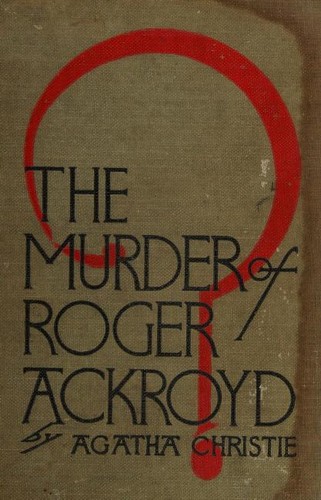
Talk to The Murder of Roger Ackroyd like its author wrote you back.
Get the ideas that fit your life — not generic summaries.
- Chat with the book
- Audiobook-style main ideas
- Adapts to your life and goals
- Helps you take action
The Murder of Roger Ackroyd, in detail
Roger Ackroyd, a wealthy widower in the English village of King's Abbot, is found stabbed in his study the evening after confiding to a friend that a blackmailer has driven his new fiancée to suicide. Hercule Poirot — recently retired, keeping vegetable marrows — is persuaded to investigate. The story is narrated by Dr. Sheppard, the local physician and Roger's friend, who becomes Poirot's Watson-style companion throughout the inquiry. What follows is Christie at her most formally daring.
Published in 1926, the novel caused genuine controversy because of what Christie does with her narrator. Without spoiling the solution entirely: the question of who can be trusted to tell the truth is not merely thematic but structural, embedded in the very mechanism by which the reader receives information. Christie exploits a fundamental convention of the genre and turns it against the reader with complete precision. The solution is technically fair — every relevant detail is present — but the game is played at a different level than readers expect.
The Murder of Roger Ackroyd holds a particular place in the history of crime fiction as the moment the genre became self-aware about its own conventions. Dorothy Sayers defended it; some early readers cried foul. The debate has never entirely resolved, which is itself a sign of how effectively Christie found a nerve. Beyond the trick, the novel is also excellent on village dynamics — the quiet suffocations of respectability, the secrets that English country life requires everyone to maintain.
Readers who want fair-play mystery solved cleanly will find this one of the most satisfying and most infuriating novels in the genre. Those who feel the solution crosses a line will not be wrong on their own terms. It is a book that divides people, and that division is part of what makes it worth discussing.
The big ideas
- 1.
Christie exploits the Watson convention — the reliable companion-narrator — with surgical precision, turning the form's most trusted element against the reader.
- 2.
The novel argues, implicitly, that respectability is itself a kind of crime: the village's entire social fabric depends on secrets that no one is willing to speak aloud.
- 3.
Every statement in the novel is technically truthful; the manipulation is achieved through omission and framing, which raises real questions about what fair play in fiction actually means.
