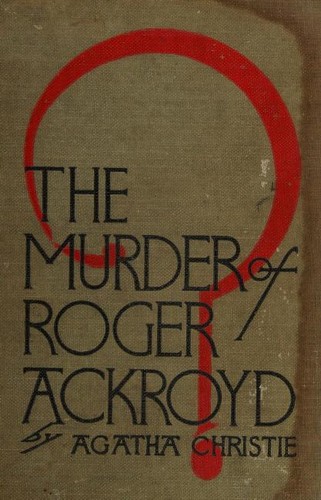
The Murder of Roger Ackroyd by Agatha Christie is a 1926 mystery book about unreliable narration, complicity and guilt, secrets and respectability. Christie exploits the Watson convention — the reliable companion-narrator — with surgical precision, turning the form's most trusted element against the reader.
Summary
Roger Ackroyd, a wealthy widower in the English village of King's Abbot, is found stabbed in his study the evening after confiding to a friend that a blackmailer has driven his new fiancée to suicide. Hercule Poirot — recently retired, keeping vegetable marrows — is persuaded to investigate. The story is narrated by Dr. Sheppard, the local physician and Roger's friend, who becomes Poirot's Watson-style companion throughout the inquiry. What follows is Christie at her most formally daring.
Published in 1926, the novel caused genuine controversy because of what Christie does with her narrator. Without spoiling the solution entirely: the question of who can be trusted to tell the truth is not merely thematic but structural, embedded in the very mechanism by which the reader receives information. Christie exploits a fundamental convention of the genre and turns it against the reader with complete precision. The solution is technically fair — every relevant detail is present — but the game is played at a different level than readers expect.
The Murder of Roger Ackroyd holds a particular place in the history of crime fiction as the moment the genre became self-aware about its own conventions. Dorothy Sayers defended it; some early readers cried foul. The debate has never entirely resolved, which is itself a sign of how effectively Christie found a nerve. Beyond the trick, the novel is also excellent on village dynamics — the quiet suffocations of respectability, the secrets that English country life requires everyone to maintain.
Readers who want fair-play mystery solved cleanly will find this one of the most satisfying and most infuriating novels in the genre. Those who feel the solution crosses a line will not be wrong on their own terms. It is a book that divides people, and that division is part of what makes it worth discussing.
Talk to The Murder of Roger Ackroyd like its author wrote you back.
Get the ideas that fit your life — not generic summaries.
- Chat with the book
- Audiobook-style main ideas
- Adapts to your life and goals
- Helps you take action
Key takeaways
- 1.
Christie exploits the Watson convention — the reliable companion-narrator — with surgical precision, turning the form's most trusted element against the reader.
- 2.
The novel argues, implicitly, that respectability is itself a kind of crime: the village's entire social fabric depends on secrets that no one is willing to speak aloud.
- 3.
Every statement in the novel is technically truthful; the manipulation is achieved through omission and framing, which raises real questions about what fair play in fiction actually means.
- 4.
Poirot's genius here is not deduction but empathy: he understands the psychology of the crime long before he assembles the evidence.
- 5.
The book was controversial on publication and remains so — it is one of the few crime novels where the dispute about the solution is itself a legitimate critical conversation.
- 6.
Christie's village is a pressure cooker of class anxiety, financial desperation, and suppressed desire — murder in this world is always the eruption of things that should have been said earlier.
- 7.
The narrator's relationship with the reader is a performance; once you know this, rereading reveals how carefully Christie embedded the deception in every scene.
- 8.
The novel is a meditation on complicity: how far does a person's silence make them responsible for what follows?
Discussion questions
Use these on your own, with a book club, or as chat starters in Superbook. Book club version, ready to copy or print →
- 1.
The ending is controversial. After finishing, do you think Christie played fair, or did she break an implicit contract with the reader? Where exactly is the line?
- 2.
The narrator is meticulous about what he includes and what he leaves out. How does Christie use the conventions of a reliable narrator to set up the deception?
- 3.
Poirot is semi-retired when the case begins. Does his reluctance to investigate change the moral texture of his eventual intervention?
- 4.
The village of King's Abbot is built on secrets. Which secrets — not the murder itself — did you find most striking, and what do they say about the English village as Christie imagines it?
- 5.
The solution requires the reader to accept that a certain kind of person is capable of a certain kind of act. Did you find that believable, or does it require you to revise your reading of every earlier scene?
- 6.
The novel was published in 1926 and immediately controversial. What does the longevity of that controversy tell us about the norms of detective fiction as a genre?
- 7.
Compared to Death on the Nile, which uses a more conventional hidden-killer setup, which do you think is the better novel? Why?
- 8.
Christie's Poirot often makes moral judgments about the crimes he solves. What is his implicit judgment here, and do you share it?
- 9.
Several characters have financial motives. How does Christie use money — inheritance, debt, blackmail — as the connective tissue of English village crime?
- 10.
The blackmail subplot drives the murder but also implicates the victim as not entirely innocent. Does that change how you feel about his death?
- 11.
Rereading the novel knowing the solution: which moments did Christie hide in plain sight that you missed on first reading?
- 12.
Christie was accused of cheating. Defenders argued the solution is technically fair. Which position do you hold, and what principle are you applying?
Themes
Frequently asked questions
-
Is The Murder of Roger Ackroyd worth reading?
Yes, but know what you're getting into. It's a landmark of the genre specifically because of what it does with its narrator. If you don't know the famous twist, resist looking it up — the experience of discovering it firsthand is irreplaceable. If you do know it, it's worth reading to see how precisely Christie embedded the deception.
-
Is the ending fair?
By strict fair-play standards, yes — every clue is present in the text. By a looser standard of reader trust, opinions are divided and have been since 1926. The novel is partly about where that line sits, and the debate is worth having with your book club.
-
Do I need to read other Poirot novels first?
No. Like most Christie, it stands alone. Poirot's character is introduced with enough context to follow. That said, if you've read Murder on the Orient Express first, you'll come to this with useful expectations that Christie will subvert.
-
Who shouldn't read this?
Readers who feel betrayed rather than delighted by narrative misdirection. If you want a straightforward whodunit that rewards careful logical deduction without formal tricks, Christie's other novels serve that better. This one plays a different game.
-
Is there an adaptation?
The 2018 BBC adaptation with David Suchet as Poirot and Matthew Goode as the narrator is highly regarded. There is also a 2024 adaptation. Both handle the solution differently, and comparing them is a useful discussion prompt in itself.
Similar books
In Cold Blood
Truman Capote
The Confidence Game: Why We Fall for It Every Time
Maria Konnikova
The Spy and the Traitor: The Greatest Espionage Story of the Cold War
Ben Macintyre
Death on the Nile
Agatha Christie
