Politics · Book club
The Network State book club questions
Here are 12 book club questions for The Network State by Balaji Srinivasan, ordered to open easily and end somewhere worth arguing about. Copy them, print them, or bring them up one at a time.
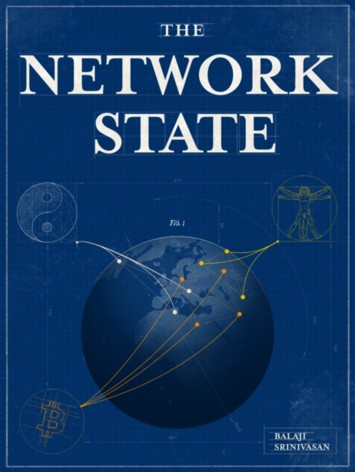
The Network State is Balaji Srinivasan's manifesto for a new kind of political entity: a community that begins as an online network with shared values, grows into a physical presence distributed across multiple countries, and eventually accumulates enough land, population, and international recognition to be treated as a state.
Balaji Srinivasan · 2022 · 13h 15m
Full summary and key takeaways →The 12 questions
- 1.
Srinivasan argues the nation-state is in structural decline. What evidence do you find most and least convincing in that argument?
- 2.
The network state concept relies heavily on voluntary exit as the mechanism for accountability. What kinds of problems does exit solve that voice doesn't, and vice versa?
- 3.
The book proposes that communities form around a 'moral innovation' — a specific value proposition. Can you think of an existing community that fits that description? What's its moral innovation?
- 4.
Srinivasan distinguishes NYT-legibility from blockchain-legibility. Is that distinction as clean as he presents it, or does cryptographic proof still depend on social consensus at some level?
- 5.
The hardest part of the network state theory is the monopoly on legitimate force. How do you think Srinivasan's framework actually resolves — or fails to resolve — that problem?
- 6.
Historical experiments in intentional political community — Seasteading, intentional communities, charter cities — have mostly failed to scale. What does that record imply about the network state concept?
- 7.
The book is explicitly written from a techno-libertarian perspective that privileges exit over redistribution. What political questions does that framing make it hard to address?
- 8.
Network states would initially rely on the legal systems of host countries for most governance. At what point does that dependency undermine the 'state' claim?
- 9.
Who gets to define the community's founding values, and what recourse does a dissenting minority within a network state have?
- 10.
Srinivasan is optimistic about the ability of online communities to maintain alignment at scale. What historical evidence bears on that optimism?
- 11.
If a network state concept were applied to something you care about — education, healthcare, housing — what would the 'moral innovation' be?
- 12.
The book runs to two hundred thousand words. Does its length reflect intellectual depth or a failure of editorial discipline? What would be lost if it were half as long?
How to run the discussion
- Pick six to eight, not all of them. An hour of real discussion covers fewer questions than anyone expects, and racing the list is what makes a book club feel like homework.
- Open with what people noticed, not what they concluded. Asking for a verdict first hardens opinions before anyone has heard each other.
- Let the disagreement run. The questions below that split a room are the ones worth the time; the ones everyone answers the same way can be skipped.
- Ask the quiet person a specific question. A direct, narrow question is far easier to answer than an open invitation to contribute.
Themes worth steering toward
If the conversation stalls, these are the threads that usually restart it.
Common questions
What are good book club questions for The Network State?
Here are 12 book club questions for The Network State by Balaji Srinivasan, ordered to open easily and end somewhere worth arguing about. The strongest openers ask what each reader noticed rather than what they concluded, and the discussion usually turns on startup cities, political innovation, decentralization.
How long should a book club discussion of The Network State last?
Most groups run 60 to 90 minutes of actual discussion. That is roughly six to eight questions, not all of them, so pick the ones that suit your group rather than working down the list in order.
What are the main themes in The Network State?
Startup cities, Political innovation, Decentralization, Technology and governance, Nation-states. Those are the threads most likely to divide a room, which makes them the useful places to steer a discussion that has gone quiet.
Picking the next one? See books like The Network State or questions for other book club picks.
