Philosophy · Book club
The New Typography book club questions
Here are 11 book club questions for The New Typography by Jan Tschichold, ordered to open easily and end somewhere worth arguing about. Copy them, print them, or bring them up one at a time.
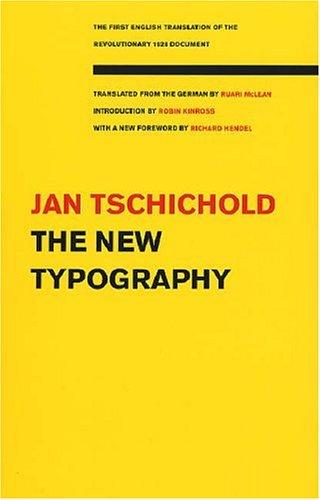
The New Typography, published in German in 1928 as Die neue Typographie, is Jan Tschichold's manifesto for a modernist approach to printed communication.
Jan Tschichold · 1928 · 4h 20m
Full summary and key takeaways →The 11 questions
- 1.
Tschichold argues that decorative typography imposes convention over clarity. Do you agree? Can ornament and legibility coexist, or is the tradeoff real?
- 2.
The book was written as a manifesto. How does that rhetorical form affect its arguments? What does Tschichold's certainty at 26 tell us about design manifestos generally?
- 3.
Tschichold later renounced much of The New Typography. Does that change how you read it? Is a self-refuted manifesto more or less interesting?
- 4.
The sans-serif typeface became associated with modernism and honesty. Is that association still meaningful, or has it become just another convention?
- 5.
The book argues that typography should serve communication above all. Are there legitimate purposes for typography that have nothing to do with efficiency of reading?
- 6.
How much of contemporary graphic design — websites, apps, publications — still operates under the assumptions Tschichold laid out in 1928?
- 7.
Tschichold was working in letterpress. How does the shift to digital production change which of his arguments still apply?
- 8.
The New Typography was written during the Weimar Republic. Tschichold fled Nazi Germany in 1933 partly because his work was labeled 'cultural Bolshevism.' What does that political context add to reading the book?
- 9.
Which contemporary designers or design systems seem most directly descended from Tschichold's principles? Which most deliberately contradict them?
- 10.
The book is prescriptive in a way that contemporary design education rarely is. Is there value in strong prescriptions in design, or does dogma always eventually cause harm?
- 11.
Tschichold later worked on classical book design and typeface development. How do you reconcile the two phases of his career?
How to run the discussion
- Pick six to eight, not all of them. An hour of real discussion covers fewer questions than anyone expects, and racing the list is what makes a book club feel like homework.
- Open with what people noticed, not what they concluded. Asking for a verdict first hardens opinions before anyone has heard each other.
- Let the disagreement run. The questions below that split a room are the ones worth the time; the ones everyone answers the same way can be skipped.
- Ask the quiet person a specific question. A direct, narrow question is far easier to answer than an open invitation to contribute.
Themes worth steering toward
If the conversation stalls, these are the threads that usually restart it.
Common questions
What are good book club questions for The New Typography?
Here are 11 book club questions for The New Typography by Jan Tschichold, ordered to open easily and end somewhere worth arguing about. The strongest openers ask what each reader noticed rather than what they concluded, and the discussion usually turns on typography, modernism, graphic design.
How long should a book club discussion of The New Typography last?
Most groups run 60 to 90 minutes of actual discussion. That is roughly six to eight questions, not all of them, so pick the ones that suit your group rather than working down the list in order.
What are the main themes in The New Typography?
Typography, Modernism, Graphic design, Functionalism, Visual communication. Those are the threads most likely to divide a room, which makes them the useful places to steer a discussion that has gone quiet.
Picking the next one? See books like The New Typography or questions for other book club picks.
