History · Book club
The Origins of Totalitarianism book club questions
Here are 12 book club questions for The Origins of Totalitarianism by Hannah Arendt, ordered to open easily and end somewhere worth arguing about. Copy them, print them, or bring them up one at a time.
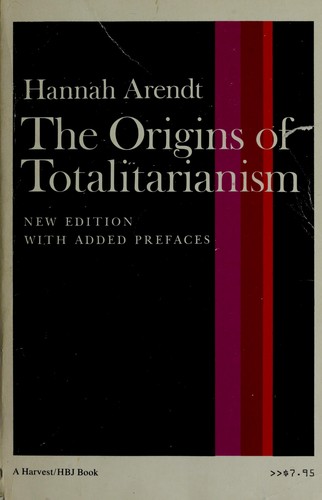
Hannah Arendt published The Origins of Totalitarianism in 1951, just six years after the end of World War II.
Hannah Arendt · 1951 · 13h 30m
Full summary and key takeaways →The 12 questions
- 1.
Arendt argues totalitarianism was genuinely unprecedented. What does that claim require us to give up in terms of historical analogy and comparison?
- 2.
She traces the origins of Nazi ideology partly through the history of European imperialism. Does that connection hold up, and what does it imply about European self-understanding?
- 3.
Arendt describes the atomization and loneliness of mass society as preconditions for totalitarianism. Where do you see comparable conditions today?
- 4.
What is the difference between Arendt's concept of totalitarianism and ordinary authoritarianism or dictatorship? Does that distinction still matter in contemporary political analysis?
- 5.
Her analysis of propaganda suggests that the goal is not to deceive people about facts but to destroy their capacity to trust facts at all. What examples does that idea bring to mind?
- 6.
Arendt argues human rights are meaningful only when backed by political membership and citizenship. What does that imply for how we think about stateless people and refugees today?
- 7.
How does the book's three-part structure — antisemitism, imperialism, totalitarianism — shape its argument? Could those elements be understood independently, or does the sequence matter?
- 8.
Arendt's prose is notoriously dense and philosophical. What does that kind of writing demand of its readers, and is the difficulty justified by what you gain from it?
- 9.
The book was written in 1951. Which parts feel most dated, and which feel most prescient given the last twenty years of political history?
- 10.
Arendt later wrote about the 'banality of evil' in Eichmann in Jerusalem. How does her argument in Origins prefigure that idea?
- 11.
What does Arendt think makes people susceptible to totalitarian ideology? Is her explanation primarily structural, psychological, or ideological?
- 12.
The book ends without a clear prescription for preventing totalitarianism. Is that absence a weakness or a form of intellectual honesty?
How to run the discussion
- Pick six to eight, not all of them. An hour of real discussion covers fewer questions than anyone expects, and racing the list is what makes a book club feel like homework.
- Open with what people noticed, not what they concluded. Asking for a verdict first hardens opinions before anyone has heard each other.
- Let the disagreement run. The questions below that split a room are the ones worth the time; the ones everyone answers the same way can be skipped.
- Ask the quiet person a specific question. A direct, narrow question is far easier to answer than an open invitation to contribute.
Themes worth steering toward
If the conversation stalls, these are the threads that usually restart it.
Common questions
What are good book club questions for The Origins of Totalitarianism?
Here are 12 book club questions for The Origins of Totalitarianism by Hannah Arendt, ordered to open easily and end somewhere worth arguing about. The strongest openers ask what each reader noticed rather than what they concluded, and the discussion usually turns on totalitarianism, political philosophy, antisemitism.
How long should a book club discussion of The Origins of Totalitarianism last?
Most groups run 60 to 90 minutes of actual discussion. That is roughly six to eight questions, not all of them, so pick the ones that suit your group rather than working down the list in order.
What are the main themes in The Origins of Totalitarianism?
Totalitarianism, Political philosophy, Antisemitism, Imperialism, Human rights. Those are the threads most likely to divide a room, which makes them the useful places to steer a discussion that has gone quiet.
Picking the next one? See books like The Origins of Totalitarianism or questions for other book club picks.
