Science · Book club
The Origins of Virtue: Human Instincts and the Evolution of Cooperation book club questions
Here are 11 book club questions for The Origins of Virtue: Human Instincts and the Evolution of Cooperation by Matt Ridley, ordered to open easily and end somewhere worth arguing about. Copy them, print them, or bring them up one at a time.
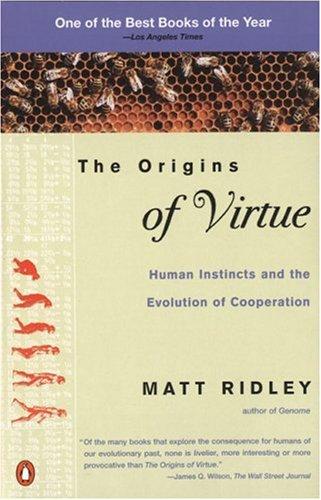
The Origins of Virtue begins from a puzzle: humans cooperate extensively with non-relatives, a behavior that seems to contradict the logic of natural selection, which predicts that organisms should act in the interests of their genes and close kin.
Matt Ridley · 1996 · 7h 15m
Full summary and key takeaways →The 11 questions
- 1.
Ridley argues that cooperation is a product of evolution rather than a contradiction of it. Does this explanation change how you think about human goodness or morality?
- 2.
The tit-for-tat strategy works in iterated games with memory. Where in your own professional or social life do you see people applying something like tit-for-tat, whether deliberately or not?
- 3.
Ridley draws on Ostrom's commons research to argue that community-managed resources often work better than state-managed ones. What conditions seem necessary for this to hold?
- 4.
The book suggests that moral intuitions like fairness and reciprocity are evolutionary adaptations. Does an evolutionary origin make these intuitions more or less authoritative as moral guides?
- 5.
Kin selection predicts that people will cooperate more readily with genetic relatives. Where does this actually show up in your life, and where does it break down?
- 6.
Ridley is skeptical about centralized management of resources and cooperation. How do you evaluate this argument? Where do you think his skepticism is warranted and where does it go too far?
- 7.
The book uses game theory to explain cooperation. What are the limits of applying mathematical models of strategy to actual human social behavior?
- 8.
Hunter-gatherer division of labor is presented as a human universal. What does this imply about the naturalness of economic exchange and specialization?
- 9.
Ridley argues that too much government intervention crowds out voluntary cooperation. Is there evidence in your own experience that this tradeoff exists?
- 10.
Cooperation requires reputation — others need to know your history of keeping or breaking agreements. How does digital technology change the conditions under which reputation can operate?
- 11.
The book ends with a cautious optimism about human nature. Do you find this optimism persuasive given the evidence it rests on?
How to run the discussion
- Pick six to eight, not all of them. An hour of real discussion covers fewer questions than anyone expects, and racing the list is what makes a book club feel like homework.
- Open with what people noticed, not what they concluded. Asking for a verdict first hardens opinions before anyone has heard each other.
- Let the disagreement run. The questions below that split a room are the ones worth the time; the ones everyone answers the same way can be skipped.
- Ask the quiet person a specific question. A direct, narrow question is far easier to answer than an open invitation to contribute.
Themes worth steering toward
If the conversation stalls, these are the threads that usually restart it.
Common questions
What are good book club questions for The Origins of Virtue: Human Instincts and the Evolution of Cooperation?
Here are 11 book club questions for The Origins of Virtue: Human Instincts and the Evolution of Cooperation by Matt Ridley, ordered to open easily and end somewhere worth arguing about. The strongest openers ask what each reader noticed rather than what they concluded, and the discussion usually turns on cooperation, evolution, human nature.
How long should a book club discussion of The Origins of Virtue: Human Instincts and the Evolution of Cooperation last?
Most groups run 60 to 90 minutes of actual discussion. That is roughly six to eight questions, not all of them, so pick the ones that suit your group rather than working down the list in order.
What are the main themes in The Origins of Virtue: Human Instincts and the Evolution of Cooperation?
Cooperation, Evolution, Human nature, Game theory, Morality. Those are the threads most likely to divide a room, which makes them the useful places to steer a discussion that has gone quiet.
Picking the next one? See books like The Origins of Virtue: Human Instincts and the Evolution of Cooperation or questions for other book club picks.
