Biography · Book club
The Path to Power book club questions
Here are 11 book club questions for The Path to Power by Robert A. Caro, ordered to open easily and end somewhere worth arguing about. Copy them, print them, or bring them up one at a time.
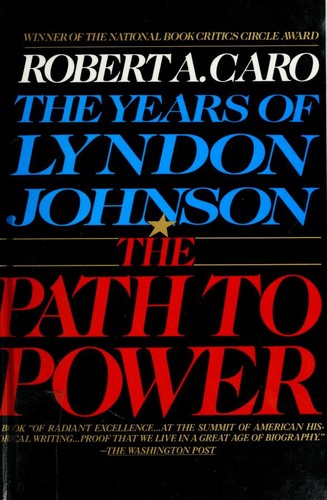
The 11 questions
- 1.
Caro treats Johnson's dishonesty as a fact to be understood rather than condemned. Do you find that approach appropriate, or does it risk minimizing the harm caused by the lies?
- 2.
The Hill Country sections are the most unexpected in a political biography. Why does Caro spend so much time on a region rather than on the man?
- 3.
Johnson stole the 1941 Senate primary. How does the biography prepare you for that revelation, and how do you weigh it against his legislative achievements?
- 4.
The relationship between Johnson and his father Sam is presented as central to his psychological formation. How persuasive do you find Caro's account of that influence?
- 5.
Caro has been working on the LBJ biography since 1975. The fifth volume is still unfinished. What does that scale of commitment produce that a more conventional multi-year project cannot?
- 6.
Johnson's congressional career in the 1940s is the subject of material that is more difficult to dramatize than the Hill Country poverty sections. How does Caro manage that difficulty?
- 7.
The book contains extended digressions — on Texas history, on the New Deal's implementation, on specific political figures — that are essential to its argument. Do you find them absorbing or distracting?
- 8.
How does Volume 1 of a multi-volume biography work as a reading experience on its own? Does it feel complete?
- 9.
What does Caro's portrait of Johnson suggest about the relationship between ambition and democratic governance?
- 10.
Johnson's treatment of subordinates is already visible in his congressional aide years. What does that behavior suggest about power and accountability?
- 11.
Is there something specifically American about the story Caro is telling — about ambition, power, and the country's self-image?
How to run the discussion
- Pick six to eight, not all of them. An hour of real discussion covers fewer questions than anyone expects, and racing the list is what makes a book club feel like homework.
- Open with what people noticed, not what they concluded. Asking for a verdict first hardens opinions before anyone has heard each other.
- Let the disagreement run. The questions below that split a room are the ones worth the time; the ones everyone answers the same way can be skipped.
- Ask the quiet person a specific question. A direct, narrow question is far easier to answer than an open invitation to contribute.
Themes worth steering toward
If the conversation stalls, these are the threads that usually restart it.
Common questions
What are good book club questions for The Path to Power?
Here are 11 book club questions for The Path to Power by Robert A. Caro, ordered to open easily and end somewhere worth arguing about. The strongest openers ask what each reader noticed rather than what they concluded, and the discussion usually turns on power, ambition, texas.
How long should a book club discussion of The Path to Power last?
Most groups run 60 to 90 minutes of actual discussion. That is roughly six to eight questions, not all of them, so pick the ones that suit your group rather than working down the list in order.
What are the main themes in The Path to Power?
Power, Ambition, Texas, Politics, Poverty. Those are the threads most likely to divide a room, which makes them the useful places to steer a discussion that has gone quiet.
Picking the next one? See books like The Path to Power or questions for other book club picks.
