Business · Book club
The Personal MBA: Master the Art of Business book club questions
Here are 12 book club questions for The Personal MBA: Master the Art of Business by Josh Kaufman, ordered to open easily and end somewhere worth arguing about. Copy them, print them, or bring them up one at a time.
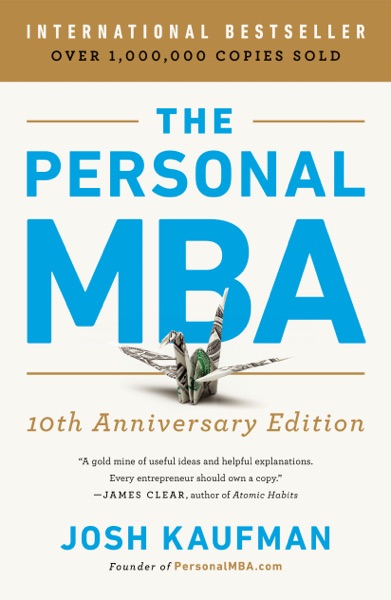
The Personal MBA makes a deliberately provocative claim: that the core concepts underlying business can be learned through self-directed reading for a fraction of the cost of an MBA program, and that most of what business schools teach is either available in books or not taught at all.
Josh Kaufman · 2010 · 7h 45m
Full summary and key takeaways →The 12 questions
- 1.
Kaufman argues that self-directed reading can substitute for an MBA. Where do you think that claim holds up, and where does the analogy break down?
- 2.
The five core business processes are value creation, marketing, sales, delivery, and finance. Which of these do you understand best in your own organization, and which is most opaque to you?
- 3.
What are the Critical Assumptions — the beliefs your current work depends on — that you have never explicitly tested?
- 4.
Kaufman says most businesses only pursue one of the four revenue-growth levers. Which lever does your organization focus on, and which of the others is most worth exploring?
- 5.
The book is organized as mental models rather than as a narrative. Does that format help you or make the ideas harder to retain?
- 6.
How much of the business knowledge you've accumulated came from formal education versus direct experience? Which was more useful?
- 7.
Kaufman argues that sunk costs are irrelevant to future decisions. Think of a recent situation where sunk-cost thinking affected a decision in your organization. What was the cost?
- 8.
The book covers psychology and human behavior alongside finance and operations. Are those genuinely part of 'business literacy,' or does bundling them together dilute both?
- 9.
What's missing from the Personal MBA curriculum that you think is essential to understand business well?
- 10.
If you had to identify the three mental models from this book most applicable to your work right now, what would they be?
- 11.
Kaufman argues for testing assumptions cheaply before committing resources. What assumption in your current work deserves a cheap test before you invest further?
- 12.
The anti-MBA framing is provocative. Does it affect how seriously you take the book, positively or negatively?
How to run the discussion
- Pick six to eight, not all of them. An hour of real discussion covers fewer questions than anyone expects, and racing the list is what makes a book club feel like homework.
- Open with what people noticed, not what they concluded. Asking for a verdict first hardens opinions before anyone has heard each other.
- Let the disagreement run. The questions below that split a room are the ones worth the time; the ones everyone answers the same way can be skipped.
- Ask the quiet person a specific question. A direct, narrow question is far easier to answer than an open invitation to contribute.
Themes worth steering toward
If the conversation stalls, these are the threads that usually restart it.
Common questions
What are good book club questions for The Personal MBA: Master the Art of Business?
Here are 12 book club questions for The Personal MBA: Master the Art of Business by Josh Kaufman, ordered to open easily and end somewhere worth arguing about. The strongest openers ask what each reader noticed rather than what they concluded, and the discussion usually turns on business fundamentals, self-education, entrepreneurship.
How long should a book club discussion of The Personal MBA: Master the Art of Business last?
Most groups run 60 to 90 minutes of actual discussion. That is roughly six to eight questions, not all of them, so pick the ones that suit your group rather than working down the list in order.
What are the main themes in The Personal MBA: Master the Art of Business?
Business fundamentals, Self-education, Entrepreneurship, Mental models, Finance. Those are the threads most likely to divide a room, which makes them the useful places to steer a discussion that has gone quiet.
Picking the next one? See books like The Personal MBA: Master the Art of Business or questions for other book club picks.
