Historical fiction · Book club
The Plot Against America book club questions
Here are 13 book club questions for The Plot Against America by Philip Roth, ordered to open easily and end somewhere worth arguing about. Copy them, print them, or bring them up one at a time.
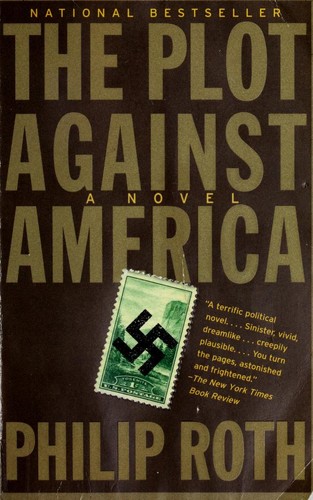
In Philip Roth's alternate history, Charles Lindbergh defeats Franklin Roosevelt in the 1940 presidential election on an America First platform, negotiates non-aggression agreements with Hitler and Hirohito, and begins a systematic program of quiet antisemitic policy that gradually shifts the conditions of Jewish American life.
Philip Roth · 2004 · 8h 45m
Full summary and key takeaways →The 13 questions
- 1.
Roth uses himself as the child narrator, placing his actual family in a counterfactual history. What does that choice gain — and risk — compared to inventing fictional characters?
- 2.
Sandy's attraction to Lindbergh's movement comes through social opportunity — a summer program, an ambitious aunt — rather than genuine ideology. Does the novel suggest ordinary people participate in bad things that way? Is that a comforting or disturbing conclusion?
- 3.
Herman Roth's stubbornness is both the family's protection and a source of difficulty. Is he the novel's moral center, or is his refusal to accommodate a form of rigidity that the novel critiques?
- 4.
The Homestead 42 program disperses Jewish families into rural America and is presented as benign integration. How does Roth show the difference between the bureaucratic description of a policy and its lived reality?
- 5.
The novel was published in 2004 and read as a Bush allegory. Rereading it after 2016 and 2024, what feels dated about that framing, and what has become more relevant?
- 6.
Lindbergh's actual political history — his America First isolationism, his antisemitic statements — is the basis for the fictional character. How does that grounding in real history change how you read the alternate history?
- 7.
Aunt Evelyn's collaboration is motivated by social aspiration and romantic attachment. Is she a villain in the novel, or is she a figure of something more complicated?
- 8.
The novel's ending returns to actual history — the war, Lindbergh's disappearance — as resolution. Does that ending satisfy you, or does it feel like a cheat?
- 9.
How does the childhood narration shape your experience of the political events? Would the novel work as well from adult Philip's perspective, looking back?
- 10.
The book is about American Jews specifically, but its argument about democratic fragility presumably applies more broadly. Does the specificity strengthen or limit the argument?
- 11.
Compare this to 1984 or Brave New World as a political fiction. What does the domestic, family-centered scale of The Plot Against America do differently?
- 12.
After reading the novel, do you find its vision of American democracy more or less fragile than you did before? Does Roth offer any resources for resistance, or only anatomy of collapse?
- 13.
The novel ends with the Lindbergh nightmare effectively over. Is that a hopeful ending about the resilience of democracy, or does the fragility of the resolution trouble you?
How to run the discussion
- Pick six to eight, not all of them. An hour of real discussion covers fewer questions than anyone expects, and racing the list is what makes a book club feel like homework.
- Open with what people noticed, not what they concluded. Asking for a verdict first hardens opinions before anyone has heard each other.
- Let the disagreement run. The questions below that split a room are the ones worth the time; the ones everyone answers the same way can be skipped.
- Ask the quiet person a specific question. A direct, narrow question is far easier to answer than an open invitation to contribute.
Themes worth steering toward
If the conversation stalls, these are the threads that usually restart it.
Common questions
What are good book club questions for The Plot Against America?
Here are 13 book club questions for The Plot Against America by Philip Roth, ordered to open easily and end somewhere worth arguing about. The strongest openers ask what each reader noticed rather than what they concluded, and the discussion usually turns on fascism and american democracy, antisemitism, fear and family.
How long should a book club discussion of The Plot Against America last?
Most groups run 60 to 90 minutes of actual discussion. That is roughly six to eight questions, not all of them, so pick the ones that suit your group rather than working down the list in order.
What are the main themes in The Plot Against America?
Fascism and American democracy, Antisemitism, Fear and family, Counterfactual history, Childhood and innocence. Those are the threads most likely to divide a room, which makes them the useful places to steer a discussion that has gone quiet.
Picking the next one? See books like The Plot Against America or questions for other book club picks.
