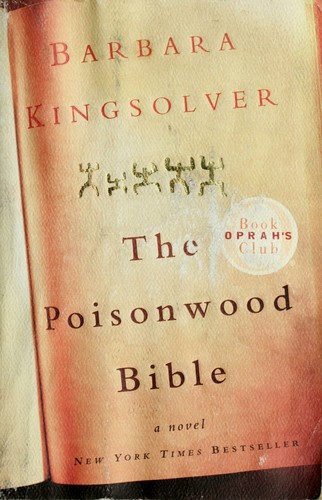
Talk to The Poisonwood Bible like its author wrote you back.
Get the ideas that fit your life — not generic summaries.
- Chat with the book
- Audiobook-style main ideas
- Adapts to your life and goals
- Helps you take action
What it argues
In 1959, Baptist missionary Nathan Price moves his wife and four daughters from Georgia to a remote village in the Belgian Congo. He goes to save souls. He does not consult the women. The Poisonwood Bible is narrated entirely through the five female voices of the Price family — Orleanna the wife and her four daughters, Rachel, Leah, Adah, and Ruth May — and the contrast between their individual relationships to Nathan's mission, and to Africa itself, is the novel's primary instrument.
The book is explicitly about American intervention in Africa: the Prices arrive in the year of Congolese independence, and the political history — the assassination of Patrice Lumumba, the CIA's role in installing Mobutu — runs in parallel to the family's private tragedy. Kingsolver makes the connection structural rather than metaphorical: Nathan's rigid insistence that his way is right even when it is killing things he plants, killing relationships, killing his family's trust, is the same logic that justified Belgian colonialism and the Cold War meddling that followed. The novel's title refers to a mistranslation Nathan makes — in Kikongo, "Tata Jesus is bangala" means "dearly beloved," but "poisonwood" is also bangala, depending on tone, and Nathan never notices the difference.
What it gets right
- 1.
The mistranslation at the novel's center — poisonwood and beloved sharing a tone-dependent word — is not just symbolism. It models the entire logic of Nathan's mission and of colonial arrogance generally.
- 2.
Kingsolver's five-voice structure gives the reader five simultaneous relationships to the same events; the divergence between them is the novel's primary argument about perception and complicity.
- 3.
The novel's political history is scrupulously researched — the Lumumba assassination and American Cold War intervention in the Congo are not backdrop but content.
What it covers
Who wrote it
Barbara Kingsolver is an American novelist, essayist, and poet who grew up in rural Kentucky and lived for several years in the Congo as a child — an experience that informed The Poisonwood Bible directly. She has a graduate degree in biology and her writing consistently engages ecology, politics, and social justice. Other major novels include The Bean Trees, Prodigal Summer, Flight Behavior, and Unsheltered. She was awarded the Pulitzer Prize for Fiction in 2023 for Demon Copperhead. She lives on a farm in Virginia.
