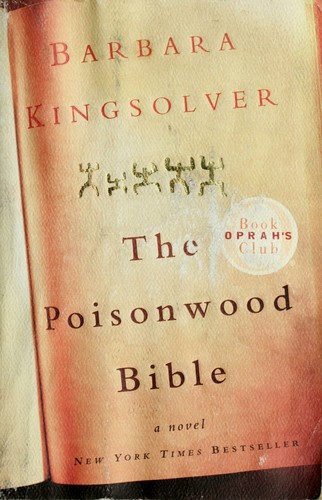
The Poisonwood Bible by Barbara Kingsolver is a 1998 literary fiction book about colonialism and its afterlives, american arrogance abroad, mothers and daughters. The mistranslation at the novel's center — poisonwood and beloved sharing a tone-dependent word — is not just symbolism. It models the entire logic of Nathan's mission and of colonial arrogance generally.
Summary
In 1959, Baptist missionary Nathan Price moves his wife and four daughters from Georgia to a remote village in the Belgian Congo. He goes to save souls. He does not consult the women. The Poisonwood Bible is narrated entirely through the five female voices of the Price family — Orleanna the wife and her four daughters, Rachel, Leah, Adah, and Ruth May — and the contrast between their individual relationships to Nathan's mission, and to Africa itself, is the novel's primary instrument.
The book is explicitly about American intervention in Africa: the Prices arrive in the year of Congolese independence, and the political history — the assassination of Patrice Lumumba, the CIA's role in installing Mobutu — runs in parallel to the family's private tragedy. Kingsolver makes the connection structural rather than metaphorical: Nathan's rigid insistence that his way is right even when it is killing things he plants, killing relationships, killing his family's trust, is the same logic that justified Belgian colonialism and the Cold War meddling that followed. The novel's title refers to a mistranslation Nathan makes — in Kikongo, "Tata Jesus is bangala" means "dearly beloved," but "poisonwood" is also bangala, depending on tone, and Nathan never notices the difference.
The five-voice structure is demanding and earns its demands. Each daughter has a fully distinct register — Adah, who is partially paralyzed and reads everything backward, is the most formally distinctive — and the voices age and change across a narrative that spans decades. Kingsolver is particularly good at the long aftermath: the novel follows the daughters' divergent adult lives and the ways they each carry or refuse the guilt of what the family participated in.
The Poisonwood Bible is a novel with an argument it believes in. Readers who find that slightly taxing — where the political thesis is occasionally visible through the skin of the fiction — are not wrong. But the ambition is real, the execution is largely controlled, and the Leah-Adah relationship in particular reaches something genuinely great. For a book about guilt and complicity, it is surprisingly emotionally alive.
Talk to The Poisonwood Bible like its author wrote you back.
Get the ideas that fit your life — not generic summaries.
- Chat with the book
- Audiobook-style main ideas
- Adapts to your life and goals
- Helps you take action
Key takeaways
- 1.
The mistranslation at the novel's center — poisonwood and beloved sharing a tone-dependent word — is not just symbolism. It models the entire logic of Nathan's mission and of colonial arrogance generally.
- 2.
Kingsolver's five-voice structure gives the reader five simultaneous relationships to the same events; the divergence between them is the novel's primary argument about perception and complicity.
- 3.
The novel's political history is scrupulously researched — the Lumumba assassination and American Cold War intervention in the Congo are not backdrop but content.
- 4.
Nathan Price is not simply a villain. He is a recognizable type: a man so certain of his righteousness that evidence of harm cannot reach him. The novel is interested in how this type gets produced.
- 5.
The daughters' adult lives diverge sharply: one stays in Africa, one becomes a diplomat's wife, one dies young, one lives with the damage. Kingsolver refuses the neat reunion narrative.
- 6.
Adah's reverse reading — her habit of palindromes and backward text — is a formal commitment to the idea that the same words mean different things depending on direction. This is the novel's epistemology.
- 7.
Orleanna's guilt, carried across decades, is the novel's emotional spine. Kingsolver asks how much a person is responsible for harms done under conditions of coercion.
- 8.
The Congo itself is a character in the novel — its ecology, its politics, its languages — and Kingsolver takes the country's interiority seriously in a way that colonial literature traditionally does not.
Discussion questions
Use these on your own, with a book club, or as chat starters in Superbook. Book club version, ready to copy or print →
- 1.
Nathan Price is the catastrophic center of the novel but rarely gets a direct voice. What does it do to your reading that you only see him through his wife and daughters?
- 2.
Orleanna's prologue-narrations suggest she has spent decades processing guilt. Do you think the novel exonerates her, or holds her responsible? Where does the line fall?
- 3.
Adah is the most formally strange narrator — palindromes, backward readings, her body as a kind of argument. Did her sections work for you, or did they feel like a writerly imposition?
- 4.
The novel makes an explicit parallel between Nathan's mission and American policy in the Congo. Does that parallel feel earned by the narrative, or does it sometimes feel like the thesis wearing the story as a costume?
- 5.
Each daughter's adult path is very different. Which one's resolution felt most honest to you, and which felt most convenient for Kingsolver's purposes?
- 6.
Leah stays in the Congo and marries a Congolese man. Is her choice presented as the morally correct response to the family's guilt, or does the novel complicate it?
- 7.
The death of Ruth May is the pivot of the novel. Did it land with the weight Kingsolver clearly intends, or had the novel's political machinery made you somewhat distanced by that point?
- 8.
Rachel, the eldest daughter, becomes a hotel owner in a former French colony and is largely unreconstructed. What is she doing in this novel — comic relief, moral warning, something else?
- 9.
The Congo is named but the village is invented. How does this mixture of historical specificity and fictional particularity affect how you trust the novel?
- 10.
Kingsolver's politics are not hidden — she believes American intervention in Africa was catastrophic. Does knowing the novelist's argument in advance change how you read the narrative choices?
- 11.
Is The Poisonwood Bible a novel about colonialism, or a novel about a family, or is the distinction false by design?
- 12.
The book sold enormously and was an Oprah pick. Does its popular success say anything about which kinds of political fiction get amplified in American culture?
- 13.
Compare it to Chinua Achebe's Things Fall Apart, which covers some of the same colonial encounter from the African side. What does Kingsolver's choice of white American narrators add or lose?
Themes
Frequently asked questions
-
Is The Poisonwood Bible worth reading?
Yes — it is one of the most ambitious American novels of the 1990s, and the five-voice structure pays off in ways that become clearer in the final third. It has a political thesis that is never hidden, which some readers find bracing and others find heavy-handed. If you are interested in American complicity in Africa, or in how ideology damages families, this is essential.
-
Is The Poisonwood Bible based on a true story?
The Price family is fictional, but the political history is accurate. Kingsolver grew up in the Congo as a child and researched the Lumumba assassination and American CIA involvement extensively. The village of Kilanga is invented; the country and its history are real.
-
How long does it take to read The Poisonwood Bible?
The novel is around 550 pages and takes most readers ten to fourteen hours. The five narrators require some initial orientation, but the voices distinguish quickly, and the novel picks up pace in its second half.
-
Is The Poisonwood Bible anti-Christian?
It is anti-Nathan Price, who is a specific kind of missionary, not a criticism of Christianity in general. Kingsolver is critical of religious certainty deployed as a tool of cultural domination. The novel takes African religious practice seriously and does not frame it as superstition.
-
Who shouldn't read The Poisonwood Bible?
Readers who find political fiction with a visible thesis frustrating, or who want their narrator to be someone other than a white American family watching Africa. The novel does not pretend to give a Congolese interiority — it is about American blindness. If that limitation bothers you more than it interests you, this may not be your book.