Fantasy · Book club
The Poppy War book club questions
Here are 12 book club questions for The Poppy War by R.F. Kuang, ordered to open easily and end somewhere worth arguing about. Copy them, print them, or bring them up one at a time.
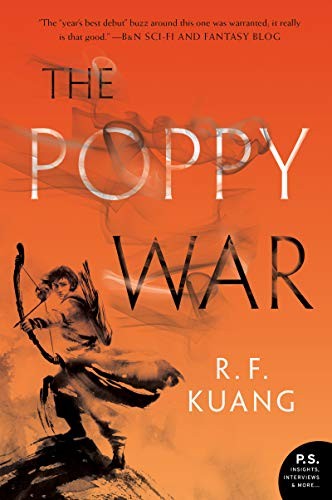
Rin is a war orphan from a poor southern province who claws her way into Sinegard, the empire's elite military academy, by acing an exam she was never supposed to pass.
R.F. Kuang · 2018 · 10h 45m
Full summary and key takeaways →The 12 questions
- 1.
The novel shifts genre — school story to war epic to something close to horror — mid-book. Did the shift work for you, or did it feel like whiplash?
- 2.
Rin is driven by resentment and the desire to prove herself from the first chapter. By the end, how much of her worst choices can be traced to those early motivations?
- 3.
Kuang has been explicit that the Mugen massacre sequences are based on the Nanjing Massacre. Does making it fantasy help or hinder engagement with that history?
- 4.
The shamanism requires something close to psychosis — the god must overwhelm the person. Does the novel treat this as metaphor, literal cost, or both?
- 5.
Sinegard selects for ruthlessness under the guise of merit. How does the school's value system set Rin up for the choices she makes in the war?
- 6.
The opium connection is explicit — shamans use it to access their power. What is Kuang saying about the relationship between imperial extraction and the people who survive it?
- 7.
Rin's mentor figures are all compromised. Does the novel have any character it presents as a moral anchor, or is it arguing that one doesn't exist?
- 8.
The violence in the third act is graphic enough that some readers stopped. Did you? If you continued, what kept you going?
- 9.
Rin's southern identity is treated as a disadvantage at every level. How does her ethnicity complicate the idea of imperial belonging?
- 10.
The novel ends in a place that forecloses most kinds of hope. Was that ending earned by what came before?
- 11.
Compared to other dark fantasy you've read, where does The Poppy War land differently in terms of what it's actually trying to do?
- 12.
Kuang was in her early twenties when she wrote this, working through grief about Chinese history she felt Western audiences ignored. Does knowing that change how you read the book?
How to run the discussion
- Pick six to eight, not all of them. An hour of real discussion covers fewer questions than anyone expects, and racing the list is what makes a book club feel like homework.
- Open with what people noticed, not what they concluded. Asking for a verdict first hardens opinions before anyone has heard each other.
- Let the disagreement run. The questions below that split a room are the ones worth the time; the ones everyone answers the same way can be skipped.
- Ask the quiet person a specific question. A direct, narrow question is far easier to answer than an open invitation to contribute.
Themes worth steering toward
If the conversation stalls, these are the threads that usually restart it.
Common questions
What are good book club questions for The Poppy War?
Here are 12 book club questions for The Poppy War by R.F. Kuang, ordered to open easily and end somewhere worth arguing about. The strongest openers ask what each reader noticed rather than what they concluded, and the discussion usually turns on war and atrocity, colonialism and power, trauma and survival.
How long should a book club discussion of The Poppy War last?
Most groups run 60 to 90 minutes of actual discussion. That is roughly six to eight questions, not all of them, so pick the ones that suit your group rather than working down the list in order.
What are the main themes in The Poppy War?
War and atrocity, Colonialism and power, Trauma and survival, Identity and belonging, Shamanism and divinity. Those are the threads most likely to divide a room, which makes them the useful places to steer a discussion that has gone quiet.
Picking the next one? See books like The Poppy War or questions for other book club picks.
