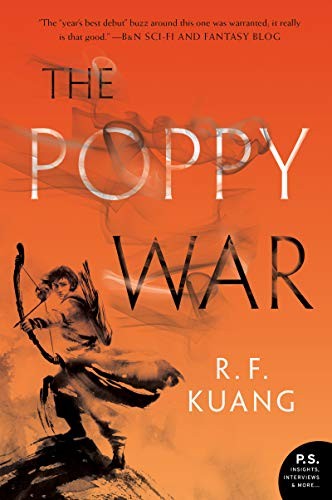
The Poppy War by R.F. Kuang is a 2018 fantasy book about war and atrocity, colonialism and power, trauma and survival. Fantasy can carry the full weight of real atrocity — Kuang refuses the genre's usual tendency to aestheticize suffering and forces the horror to land.
Summary
Rin is a war orphan from a poor southern province who claws her way into Sinegard, the empire's elite military academy, by acing an exam she was never supposed to pass. The Poppy War begins as a school story — brutal, competitive, stratified by class and ethnicity — but the genre shifts mid-novel as the Mugen Federation invades and the story becomes something far darker. Kuang, drawing heavily on twentieth-century Chinese history including the Second Sino-Japanese War and the Nanjing Massacre, uses fantasy not to soften that history but to metabolize it.
The book is really about what war does to people, specifically what it asks of them. Rin discovers she can channel a god — a fire deity associated with destruction — and the novel treats this power not as triumphant but as corrosive. The question isn't whether she can win but whether winning at the cost of what it requires is survivable. The shamanism system is intertwined with opium use and psychological fracture, which is not a coincidence. Kuang is drawing a line between colonialism, the opium trade, and the trauma passed down through generations.
The prose is blunt and precise; there is no pleasure in the violence. The third act is graphic and deliberately difficult to read. Kuang has said she wanted to force Western readers to sit with atrocities they routinely sanitize when they are distant or Asian. The structural choice — school story to war epic to horror — is intentional and the tonal whiplash is the point. This is not grimdark for atmosphere. It is grimdark because the history it is based on was actually like this.
Readers who want clean heroics, redemption arcs, or measured pacing will not find them here. Readers willing to have a fantasy novel make them genuinely uncomfortable, who want genre fiction that carries actual historical weight, will find The Poppy War among the most ambitious debuts of the past decade. The sequels, The Dragon Republic and The Burning God, complete the trilogy and remain consistent in their brutality and ambition.
Talk to The Poppy War like its author wrote you back.
Get the ideas that fit your life — not generic summaries.
- Chat with the book
- Audiobook-style main ideas
- Adapts to your life and goals
- Helps you take action
Key takeaways
- 1.
Fantasy can carry the full weight of real atrocity — Kuang refuses the genre's usual tendency to aestheticize suffering and forces the horror to land.
- 2.
Rin's power is inseparable from trauma and addiction; divine fire in this world doesn't elevate the hero, it hollows them out.
- 3.
The school-story opening is a deliberate setup: the competence and ambition cultivated at Sinegard are exactly what makes Rin capable of the book's worst acts.
- 4.
The novel maps colonial extraction — specifically the opium trade — onto its fantasy world so precisely that the metaphor functions as a history lesson.
- 5.
Belonging is never stable for Rin: she's too southern for the empire, too powerful for safety, too traumatized for peace. The novel refuses to give her a home.
- 6.
The shamans' relationship with their gods is not reverence but possession; the cost is sanity, which frames divinity itself as a kind of colonialism.
- 7.
Kuang's treatment of the Nanjing Massacre analogue is graphic and deliberately unredemptive — no catharsis, no lesson, just the record of what happened.
- 8.
The trilogy as a whole is about what it costs a person to become the instrument of historical change, and whether that person survives what they become.
Discussion questions
Use these on your own, with a book club, or as chat starters in Superbook. Book club version, ready to copy or print →
- 1.
The novel shifts genre — school story to war epic to something close to horror — mid-book. Did the shift work for you, or did it feel like whiplash?
- 2.
Rin is driven by resentment and the desire to prove herself from the first chapter. By the end, how much of her worst choices can be traced to those early motivations?
- 3.
Kuang has been explicit that the Mugen massacre sequences are based on the Nanjing Massacre. Does making it fantasy help or hinder engagement with that history?
- 4.
The shamanism requires something close to psychosis — the god must overwhelm the person. Does the novel treat this as metaphor, literal cost, or both?
- 5.
Sinegard selects for ruthlessness under the guise of merit. How does the school's value system set Rin up for the choices she makes in the war?
- 6.
The opium connection is explicit — shamans use it to access their power. What is Kuang saying about the relationship between imperial extraction and the people who survive it?
- 7.
Rin's mentor figures are all compromised. Does the novel have any character it presents as a moral anchor, or is it arguing that one doesn't exist?
- 8.
The violence in the third act is graphic enough that some readers stopped. Did you? If you continued, what kept you going?
- 9.
Rin's southern identity is treated as a disadvantage at every level. How does her ethnicity complicate the idea of imperial belonging?
- 10.
The novel ends in a place that forecloses most kinds of hope. Was that ending earned by what came before?
- 11.
Compared to other dark fantasy you've read, where does The Poppy War land differently in terms of what it's actually trying to do?
- 12.
Kuang was in her early twenties when she wrote this, working through grief about Chinese history she felt Western audiences ignored. Does knowing that change how you read the book?
Themes
Frequently asked questions
-
Is The Poppy War appropriate for sensitive readers?
No. The novel contains graphic depictions of mass atrocity, sexual violence, torture, and genocide in its third act. Kuang does not soften these scenes. The book is deliberately difficult and some readers have found it traumatizing. Go in knowing this.
-
Is The Poppy War based on real history?
Heavily. The Nikara Empire maps onto imperial China, the Mugen Federation onto imperial Japan, and the massacre sequences are based directly on the 1937 Nanjing Massacre. The opium and colonial dynamics also track Sino-British history. The fantasy is a vehicle for engaging with that history, not a displacement from it.
-
Do I need to read the whole trilogy?
The Poppy War is a complete act with its own shape, but the story continues in The Dragon Republic and The Burning God. The trilogy is unified by character and theme rather than plot closure, so readers who want the full arc should plan to read all three.
-
Why is this categorized as fantasy if it's basically historical fiction?
The shamanism system — gods possessing humans, divine fire — is genuinely fantastical and central to the plot. But Kuang uses the fantasy elements to literalize historical dynamics (colonial extraction, the cost of survival) rather than as escapism. It is a fantasy novel with a historical novel's seriousness.
-
Who shouldn't read The Poppy War?
Readers looking for heroic fantasy, escapist adventure, or satisfying moral resolution. The novel offers none of these. It is bleak by design and the protagonist makes choices that are not redeemable by the end of the book.