Self-help · Book club
The Power of Full Engagement book club questions
Here are 12 book club questions for The Power of Full Engagement by Jim Loehr and Tony Schwartz, ordered to open easily and end somewhere worth arguing about. Copy them, print them, or bring them up one at a time.
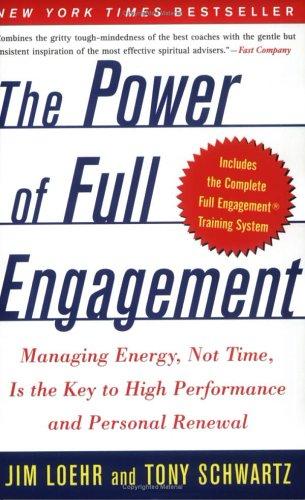
The Power of Full Engagement starts from a simple reframe: time is fixed, but energy is not.
Jim Loehr and Tony Schwartz · 2003 · 4h 20m
Full summary and key takeaways →The 12 questions
- 1.
Loehr and Schwartz say most people manage time rather than energy. Which energy dimension do you think you manage worst right now — physical, emotional, mental, or spiritual?
- 2.
The book argues that stress without recovery is the real problem, not stress itself. Where in your life have you been applying stress without giving yourself genuine recovery?
- 3.
Think about a time when you brought full engagement to something. What were the conditions that made that possible? Are those conditions present in your regular work?
- 4.
The authors use the term 'full extension' to describe the grinding, depleted state most people mistake for performance. Does that description fit your current approach to work?
- 5.
Physical energy is described as foundational. How seriously do you take sleep, nutrition, and movement as performance variables rather than just health variables?
- 6.
Spiritual energy in the book means alignment between values and daily behavior. What values do you hold most strongly? How closely does your day-to-day behavior reflect them?
- 7.
The ninety-minute work-and-recovery cycle is one of the book's most concrete recommendations. What would your day look like if you actually structured it around deliberate oscillation?
- 8.
What performance ritual — a precise, automatic behavior — would most predictably improve your energy in the first two hours of the day?
- 9.
The book was written largely from athletic training research. How well do you think that model transfers to knowledge work? Where does it fit cleanly and where does it break down?
- 10.
Loehr and Schwartz say recovery has to be real — not passive distraction like scrolling a phone, but genuine disengagement. What does actual recovery look like for you?
- 11.
The authors identify a gap between the person you want to be and how you actually behave under pressure. What specific situation reveals that gap most clearly in your own life?
- 12.
The book's corporate case studies are from the late 1990s and early 2000s. Which of the core arguments feel more relevant today than they did then, and which feel less so?
How to run the discussion
- Pick six to eight, not all of them. An hour of real discussion covers fewer questions than anyone expects, and racing the list is what makes a book club feel like homework.
- Open with what people noticed, not what they concluded. Asking for a verdict first hardens opinions before anyone has heard each other.
- Let the disagreement run. The questions below that split a room are the ones worth the time; the ones everyone answers the same way can be skipped.
- Ask the quiet person a specific question. A direct, narrow question is far easier to answer than an open invitation to contribute.
Themes worth steering toward
If the conversation stalls, these are the threads that usually restart it.
Common questions
What are good book club questions for The Power of Full Engagement?
Here are 12 book club questions for The Power of Full Engagement by Jim Loehr and Tony Schwartz, ordered to open easily and end somewhere worth arguing about. The strongest openers ask what each reader noticed rather than what they concluded, and the discussion usually turns on energy management, performance, recovery.
How long should a book club discussion of The Power of Full Engagement last?
Most groups run 60 to 90 minutes of actual discussion. That is roughly six to eight questions, not all of them, so pick the ones that suit your group rather than working down the list in order.
What are the main themes in The Power of Full Engagement?
Energy management, Performance, Recovery, Stress and renewal, Physical health. Those are the threads most likely to divide a room, which makes them the useful places to steer a discussion that has gone quiet.
Picking the next one? See books like The Power of Full Engagement or questions for other book club picks.
