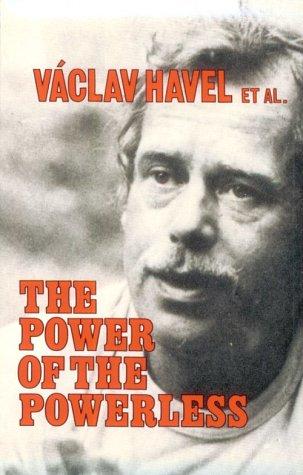
The Power of the Powerless by Václav Havel is a 1978 philosophy book about dissent, political power, authenticity. Post-totalitarianism rules not primarily through force but through participation: by requiring citizens to perform rituals of loyalty they know are false, it makes everyone complicit in maintaining the lie.
Summary
Written in 1978 and circulated as samizdat in Czechoslovakia, Václav Havel's essay is one of the most penetrating analyses of how totalitarian power actually works — and how ordinary people can resist it without armies, parties, or manifestos. Havel's central insight is that the post-Stalinist communist system he calls "post-totalitarianism" does not primarily rule by naked force. It rules by getting people to participate in their own subjugation: to say things they don't believe, perform loyalty they don't feel, and sustain a lie that everyone knows is a lie but no one will name as such.
The greengrocer who puts a sign saying "Workers of the World, Unite!" in his shop window doesn't do it because he believes it. He does it to signal compliance, to avoid trouble, and to survive. Havel argues that this act of complicity is the system's true mechanism. Every person who "lives within the lie" — who performs the rituals without believing them — adds a brick to the wall. The system does not need true believers; it needs enough people going through the motions to make dissent look strange and isolated.
The answer Havel proposes is not revolution or a counter-program. It is "living within the truth." This means simply behaving as though the things you believe are real — speaking accurately, refusing the ritual performances, insisting on treating other people as ends rather than means. It is not dramatic; it is choosing not to put the sign in the window. But Havel argues this seemingly small act is corrosive to power in a way that conventional political opposition cannot be, because it attacks the lie at its foundation rather than competing within its rules.
The essay's final sections, written before the events that made Havel famous, describe the kind of parallel civil society he believed could eventually make the system untenable. In retrospect it reads as both a philosophical argument and a prophecy. Its ideas fed directly into Charter 77 and the broader dissident movements that eventually produced the 1989 revolutions. For readers today, its value is less historical than diagnostic: the mechanisms of manufactured consent, complicity, and performative loyalty Havel describes have applications well beyond communist Czechoslovakia.
Talk to The Power of the Powerless like its author wrote you back.
Get the ideas that fit your life — not generic summaries.
- Chat with the book
- Audiobook-style main ideas
- Adapts to your life and goals
- Helps you take action
Key takeaways
- 1.
Post-totalitarianism rules not primarily through force but through participation: by requiring citizens to perform rituals of loyalty they know are false, it makes everyone complicit in maintaining the lie.
- 2.
The greengrocer who displays a political slogan is not expressing belief — he is signaling compliance. This mechanism of routine complicity is the system's true power.
- 3.
Living within the lie does not require active endorsement. Silence, routine participation, and performance of expected roles are sufficient to sustain the system.
- 4.
The antidote is 'living within the truth': behaving as though the things you believe are real, refusing performative loyalty, and treating others as ends rather than means.
- 5.
Small acts of authenticity are more threatening to power than organized opposition, because they attack the system at the level of its foundational lie rather than competing within its rules.
- 6.
A parallel civil society — independent institutions, clubs, associations, publications — creates the social infrastructure that survives and eventually outlasts the official system.
- 7.
Power that depends on manufactured consent is more brittle than power that depends on genuine legitimacy: once enough people stop performing, the system's exposure can come suddenly.
Discussion questions
Use these on your own, with a book club, or as chat starters in Superbook. Book club version, ready to copy or print →
- 1.
Havel describes participation in rituals you don't believe in as the core mechanism of totalitarian power. Where do you see analogous dynamics in non-totalitarian societies?
- 2.
The greengrocer thought putting up the sign was trivial. Havel argues it is not. What small performances of compliance do you make that you haven't examined?
- 3.
Is 'living within the truth' a realistic prescription, or does it require a level of personal courage that most people cannot sustain under pressure?
- 4.
Havel is suspicious of political movements and programs. Does that skepticism hold up when you consider how actual change has happened historically?
- 5.
He argues that parallel structures — independent institutions outside the official system — are the seeds of a successor society. What parallel structures exist in your context?
- 6.
The essay was written under communist rule, but Havel explicitly says its analysis isn't limited to communist systems. Which of his mechanisms do you see operating in democratic societies?
- 7.
What is the difference between a principled refusal to perform and an impractical purity that accomplishes nothing?
- 8.
Havel became president of Czechoslovakia after the system he described collapsed. Does that outcome validate his argument, or was there something else going on?
- 9.
The essay argues that the system's strength is also its weakness: mass complicity is inherently fragile. Does that seem right to you given what you know about how regimes actually fall?
- 10.
What does it mean to treat a person as an end rather than a means in a political context where nearly every action has strategic consequences?
- 11.
Havel is a playwright and the essay is philosophical rather than programmatic. Does that form suit the argument, or does it limit its practical usefulness?
Themes
Frequently asked questions
-
Is The Power of the Powerless still relevant?
Remarkably so. The mechanisms Havel describes — manufactured consent, performative loyalty, complicity through silence — are not specific to communism. Readers consistently find the essay applicable to their own contexts, which suggests the analysis identifies something structural about how power and deception interact.
-
How long does it take to read The Power of the Powerless?
Under two hours. The essay is around 60 pages and reads quickly despite its density. Many readers return to it because the argument repays re-reading as contexts shift.
-
What does 'living within the truth' mean?
Simply behaving as though your actual beliefs and values are real: refusing to perform loyalty you don't feel, speaking accurately about what you observe, treating other people as full human beings rather than instruments of survival. Havel emphasizes it is not a heroic act — it is the baseline of human dignity.
-
Who should read The Power of the Powerless?
Anyone interested in political philosophy, the ethics of complicity, or how ordinary people relate to unjust systems. It is short enough to assign in a single session and rich enough to generate hours of discussion.
-
How does this compare to Havel's other work?
The essay is his most systematic political argument. His plays address similar themes — the dehumanizing effects of bureaucracy and ideology — but through drama rather than argument. His later political speeches are more hopeful and less analytical. This essay remains his most influential single text.
Similar books

Sapiens: A Brief History of Humankind
Yuval Noah Harari
The People vs. Democracy: Why Our Freedom Is in Danger and How to Save It
Yascha Mounk
21 Lessons for the 21st Century
Yuval Noah Harari
