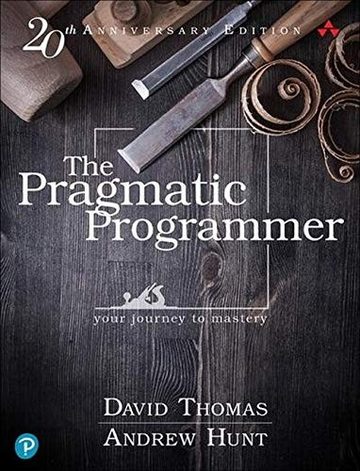
The Pragmatic Programmer by David Thomas and Andrew Hunt is a 1999 science book about software craftsmanship, career development, problem solving. DRY — Don't Repeat Yourself — means every piece of knowledge should have a single authoritative representation. Duplication causes knowledge to rot out of sync.
Summary
The Pragmatic Programmer is David Thomas and Andrew Hunt's distillation of what separates journeyman coders from craftsmen who consistently ship good work over long careers. First published in 1999 and substantially updated in 2019, it remains one of the most influential books in software development — not because it covers any single technology, but because it addresses the habits of mind and professional attitude that make a developer effective regardless of language or framework.
The core metaphor is "pragmatic": Thomas and Hunt are not interested in theoretical purity. They want software that works, ships, and can be maintained. This leads to a set of maxims that cut across the usual distinctions between junior and senior work. Don't repeat yourself (the DRY principle) is not just about copy-paste code; it's about every piece of knowledge having a single, authoritative representation in a system. Tracer bullets aren't a metaphor for prototypes — they're a method for finding the path through a problem by building a thin, working slice before filling it in. Broken windows, borrowed from urban planning, explain why small acts of disorder in a codebase compound into big ones if left unaddressed.
The 2019 edition reworks many chapters to account for modern development: cloud infrastructure, functional programming styles, and the shift toward teams. But the philosophical core is unchanged. The book argues that the best developers treat their work as a craft — investing in a personal knowledge portfolio, communicating technical decisions clearly to non-technical stakeholders, estimating honestly, and taking ownership of outcomes rather than blaming tools or requirements. The authors are blunt: if your tools are costing you time, you should feel uncomfortable. The discomfort is the signal to invest in learning better ones.
What the book is not is a step-by-step tutorial or a comprehensive engineering guide. It works best as a companion for someone already writing code who wants to think about the work differently. The chapters are short, the tone is conversational, and the exercises at the end of each section push toward reflection rather than rote practice. Experienced developers often return to it when they notice a nagging feeling that something in their workflow is wrong but can't name it.
Talk to The Pragmatic Programmer like its author wrote you back.
Get the ideas that fit your life — not generic summaries.
- Chat with the book
- Audiobook-style main ideas
- Adapts to your life and goals
- Helps you take action
Key takeaways
- 1.
DRY — Don't Repeat Yourself — means every piece of knowledge should have a single authoritative representation. Duplication causes knowledge to rot out of sync.
- 2.
Broken windows matter. Leaving a small problem unaddressed signals that nobody cares, and the codebase degrades faster from there.
- 3.
Tracer bullets find the path through a new problem by building a thin, working slice end-to-end before filling in detail. They are not throwaway prototypes.
- 4.
Treat your professional knowledge as a portfolio: diversify intentionally, invest regularly, and review whether your skills are appreciating or becoming obsolete.
- 5.
Estimate everything. A good estimate with reasoning attached is more useful than an exact deadline pulled from the air.
- 6.
Be a catalyst for change, not someone who waits for permission. The authors call it 'stone soup': start building something small and visible, and people will want to contribute.
- 7.
Design software that is easy to change. Coupling is the enemy — not because it's ugly, but because it makes future work expensive.
- 8.
Take responsibility for outcomes, not just intentions. 'I don't know' is fine; 'it's not my fault' is not.
Discussion questions
Use these on your own, with a book club, or as chat starters in Superbook. Book club version, ready to copy or print →
- 1.
Which broken windows have you left in a codebase you work in? What stopped you from fixing them at the time?
- 2.
Thomas and Hunt argue that duplication is the root of most maintenance problems. Where in your current project is knowledge duplicated, and how did that happen?
- 3.
Think about your 'knowledge portfolio' as a developer. Which skills are you investing in this year, and which ones are depreciating without your noticing?
- 4.
The tracer bullet approach suggests building thin end-to-end slices before filling in detail. When have you seen this work well, and when does it break down in practice?
- 5.
The book argues that good developers make their tools their own. What's the last tool or workflow you invested serious time in customizing? Did it pay off?
- 6.
How do you currently handle estimation in your team? Do you feel the estimates you give are honest, and what happens when they're wrong?
- 7.
The authors say good code is 'easy to change.' Think about code you've written or maintained. What made it easy or hard to change, and would you make different decisions now?
- 8.
The 'stone soup' story is about making change happen without authority. Have you ever done this successfully in an organization? What made it work?
- 9.
Where in your career have you blamed a tool, a language, or a requirement instead of finding a way around it? Looking back, was there a better path?
- 10.
Thomas and Hunt emphasize owning outcomes rather than just intentions. In software teams, where does the line between individual and collective ownership break down?
- 11.
The book recommends learning a new language every year. Is that realistic for you? What would you lose and gain by diversifying your technical knowledge more aggressively?
- 12.
If a new developer on your team read this book, which single piece of advice do you think would change their work the most? Why?
Themes
Frequently asked questions
-
Is The Pragmatic Programmer still worth reading in 2026?
Yes. The 2019 edition updated the examples and added chapters relevant to modern software teams, but the core thinking — about craftsmanship, ownership, and reducing coupling — hasn't aged. If anything it's more relevant as software systems grow more interconnected and harder to reason about.
-
What level of experience do you need to get value from this book?
Some coding experience helps, but the book isn't about syntax. Developers with two to five years of professional experience often find it most useful — enough exposure to recognize the problems it describes, not yet set enough in their habits to dismiss the advice.
-
How long does it take to read The Pragmatic Programmer?
Around five to six hours for the main text. Many readers take longer because the exercises at the end of each section are worth stopping for. The chapters are short enough to read in single sittings and act on before the next.
-
What's the single most useful idea in the book?
DRY — the principle that every piece of knowledge should have a single authoritative representation. It sounds narrow when applied to code duplication, but the authors mean it at every level: documentation, tests, business logic, configuration. Getting this right prevents entire categories of bugs.
-
Is this a technical book or a career book?
Both. The technical advice is practical and specific. But the book's real argument is about professional attitude — taking ownership, investing in skills, communicating honestly. That half applies regardless of what you're building or what language you're using.