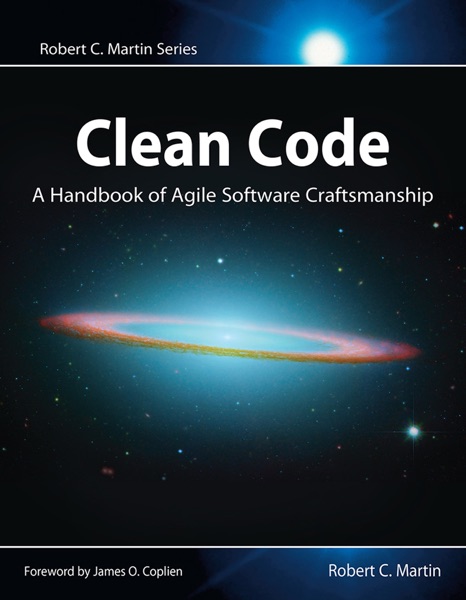
Clean Code by Robert C. Martin is a 2008 science book about software craftsmanship, readability, refactoring. The primary audience for code is other humans — including your future self. Write code to be read, not just executed.
Summary
Clean Code is Robert Martin's extended argument that writing readable, maintainable code is a professional obligation, not an optional refinement. The book opens with a blunt premise: bad code is expensive, it slows teams down exponentially over time, and programmers who write it are not doing their jobs. Martin — "Uncle Bob" — spent decades consulting at companies where the codebase had become so tangled it was paralyzing development, and the book draws on those experiences throughout.
The bulk of the book is a chapter-by-chapter treatment of specific practices: meaningful naming, short functions that do one thing, clean comments (with a strong bias toward no comments, since comments often paper over unclear code), error handling without obscuring logic, formatting, and the design of objects and data structures. Martin's rules are opinionated. Functions should be small — very small, often three to five lines. Names should be pronounceable and searchable. Comments explaining what the code does are almost always a sign the code should be rewritten instead. Some of these rules have aged differently than others, but their underlying motivation — make the code readable to a human, not just executable by a machine — remains sound.
The middle section includes chapters on unit testing and test-driven development, framing tests as first-class citizens of a codebase rather than an afterthought. Martin applies the same cleanliness criteria to tests themselves: tests should be fast, independent, repeatable, self-validating, and timely. The "three laws of TDD" — never write production code before a failing test exists, never write more of a test than is sufficient to fail — appear here and have become widely cited.
The final chapters examine systems-level design, concurrency, and a series of extended case studies where Martin refactors real code. These are among the most valuable parts of the book because they show the principles in action against messy, realistic examples. The book ends with a list of code smells and heuristics that functions as a quick-reference guide to everything covered. Whether or not readers agree with every prescription, Clean Code is the most thorough single argument that professional programmers owe their future selves — and their teams — code that communicates clearly.
Talk to Clean Code like its author wrote you back.
Get the ideas that fit your life — not generic summaries.
- Chat with the book
- Audiobook-style main ideas
- Adapts to your life and goals
- Helps you take action
Key takeaways
- 1.
The primary audience for code is other humans — including your future self. Write code to be read, not just executed.
- 2.
Functions should do one thing. If a function is doing more than one thing, it should be split. Very short functions are easier to name, test, and understand.
- 3.
Meaningful names reduce the need for comments. If the name of a variable or function requires explanation, rename it instead of explaining it.
- 4.
Comments that explain what the code does are a failure to write clear code. Comments are most valuable for explaining why — intent, constraints, or domain context that code cannot express.
- 5.
Tests are not optional. Code without unit tests is not clean code. Tests give you the freedom to refactor without fear.
- 6.
The Boy Scout Rule: leave the code cleaner than you found it. Every small improvement to the code you touch compounds over time.
- 7.
Error handling should be clean too. Using exceptions rather than error codes, writing informative messages, and not swallowing exceptions keeps error paths as readable as happy paths.
- 8.
Code smells — duplicated code, long methods, large classes, excessive comments — are signals worth responding to immediately, not tolerating.
Discussion questions
Use these on your own, with a book club, or as chat starters in Superbook. Book club version, ready to copy or print →
- 1.
Martin argues that bad code is primarily a professional failure, not a technical one. Do you agree? Have you experienced the slowdown of a messy codebase?
- 2.
His rule about function length is strict: very short, often three to five lines. Does that match how you write or prefer to read code?
- 3.
Comments that explain what code does are almost always a code smell, Martin says. What's an example where you've used a comment to avoid rewriting something?
- 4.
The Boy Scout Rule asks you to improve code whenever you touch it. What stops people from actually doing that in practice?
- 5.
Martin is firm about test-driven development. Have you used TDD? What changed about the design of your code when tests came first?
- 6.
Some of Martin's style preferences — like avoiding else clauses, keeping all objects small — are contested. Which rules do you find most useful and which feel too absolute?
- 7.
The book assumes a specific kind of software work: object-oriented, business-logic-heavy systems. How much do the rules transfer to other contexts — scripts, data pipelines, embedded code?
- 8.
What's the most useful refactoring technique you've learned, and does it appear in this book?
- 9.
Martin often shows a before and after: ugly code, then clean code. Which transformation surprised you most, and why?
- 10.
The concurrency chapter describes genuinely hard problems. What practices have you found useful for managing concurrent code that isn't covered here?
- 11.
Clean code is sometimes slower to write initially. How do you make the case to a team or manager that the upfront cost is worth it?
- 12.
How does the book's advice apply to a codebase you inherit versus one you build from scratch?
Themes
Frequently asked questions
-
Is Clean Code still worth reading in 2026?
Yes, with some caveats. The core argument — that code readability is a professional obligation — remains essential. Some specific rules are products of their Java-heavy era and should be read critically rather than applied literally in other languages or paradigms.
-
How long does it take to read Clean Code?
Roughly six hours at average pace. The case study chapters reward slower reading since following the refactoring step by step is where much of the learning happens. Many readers work through it over several sessions alongside a real project.
-
Who should read Clean Code?
Working software engineers who have started to feel the weight of messy codebases. It's less useful as a beginner text — the concepts land harder once you've experienced the costs it describes. Senior engineers will find the most useful sections are the smell list and the case studies.
-
What's the most actionable idea in the book?
The Boy Scout Rule: every time you touch code, leave it a little cleaner than you found it. Rename one bad variable. Extract one function. This compounds without requiring a big refactoring project that never gets scheduled.
-
Is the advice in Clean Code too opinionated?
Some of it is. Martin's function-length rules and his dislike of comments are more absolute than most experienced teams practice. The book is more useful as a set of principles to argue from than a rulebook to follow literally. The underlying reasoning matters more than the specific prescriptions.
Similar books
The Mythical Man-Month
Frederick P. Brooks Jr.
The Phoenix Project: A Novel About IT, DevOps, and Helping Your Business Win
Gene Kim, Kevin Behr, and George Spafford

An Elegant Puzzle
Will Larson
A Mind for Numbers
Barbara Oakley
