Philosophy · Book club
The Precipice: Existential Risk and the Future of Humanity book club questions
Here are 12 book club questions for The Precipice: Existential Risk and the Future of Humanity by Toby Ord, ordered to open easily and end somewhere worth arguing about. Copy them, print them, or bring them up one at a time.
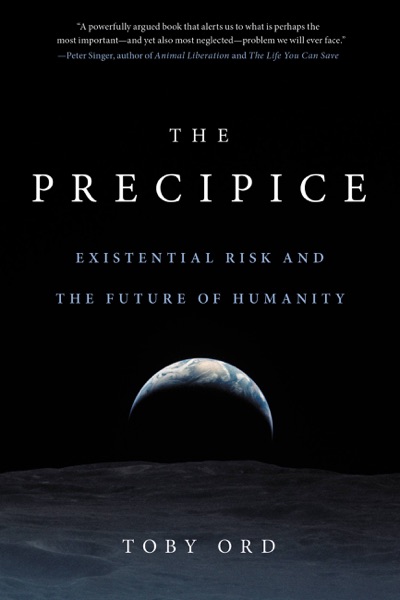
The Precipice is Oxford philosopher Toby Ord's case that humanity is living through an unusually dangerous period — one where our technological capabilities have outrun our wisdom and governance, and where a small number of risks could cut off not just this generation but all future generations.
Toby Ord · 2020 · 8h 0m
Full summary and key takeaways →The 12 questions
- 1.
Ord argues that the interests of future people should weigh heavily in our moral calculations. How does that principle square with the difficulty of knowing what future people will want?
- 2.
Does the one-in-six estimate for existential risk this century change how you think about current priorities — political, personal, or professional?
- 3.
Ord distinguishes between risks we can reduce and risks we can only accept. For which risks on his list does governance seem most tractable?
- 4.
The longtermist framework has been criticized for potentially justifying harms today for speculative future gains. Is that a fatal objection or a tractable problem?
- 5.
How does your intuition about AI risk compare with Ord's framing? Does 'misalignment' capture what you find genuinely worrying about powerful AI systems?
- 6.
Ord's treatment of value lock-in suggests that even a world with no extinction could be an existential catastrophe. What values, if locked in, would you consider existential failures?
- 7.
The book argues biosecurity is a neglected cause relative to its potential impact. What institutional features make some global risks systematically underfunded?
- 8.
How much moral weight do you give to people who will exist in the future versus people who exist now? Does your intuition shift when you try to reason about it explicitly?
- 9.
Ord acknowledges his probability estimates are highly uncertain. Does that uncertainty make the case for action weaker or stronger in your view?
- 10.
The Precipice argues we are living through a hinge of history. Does everyday experience confirm or undermine that sense for you?
- 11.
Which of the risks Ord surveys — engineered pandemics, AI, nuclear, climate — seems most amenable to collective action, and why?
- 12.
If existential risk reduction is as important as Ord argues, what does that imply for how talented people should allocate their careers?
How to run the discussion
- Pick six to eight, not all of them. An hour of real discussion covers fewer questions than anyone expects, and racing the list is what makes a book club feel like homework.
- Open with what people noticed, not what they concluded. Asking for a verdict first hardens opinions before anyone has heard each other.
- Let the disagreement run. The questions below that split a room are the ones worth the time; the ones everyone answers the same way can be skipped.
- Ask the quiet person a specific question. A direct, narrow question is far easier to answer than an open invitation to contribute.
Themes worth steering toward
If the conversation stalls, these are the threads that usually restart it.
Common questions
What are good book club questions for The Precipice: Existential Risk and the Future of Humanity?
Here are 12 book club questions for The Precipice: Existential Risk and the Future of Humanity by Toby Ord, ordered to open easily and end somewhere worth arguing about. The strongest openers ask what each reader noticed rather than what they concluded, and the discussion usually turns on existential risk, long-term future, humanity's potential.
How long should a book club discussion of The Precipice: Existential Risk and the Future of Humanity last?
Most groups run 60 to 90 minutes of actual discussion. That is roughly six to eight questions, not all of them, so pick the ones that suit your group rather than working down the list in order.
What are the main themes in The Precipice: Existential Risk and the Future of Humanity?
Existential risk, Long-term future, Humanity's potential, Moral responsibility, Technology governance. Those are the threads most likely to divide a room, which makes them the useful places to steer a discussion that has gone quiet.
Picking the next one? See books like The Precipice: Existential Risk and the Future of Humanity or questions for other book club picks.
