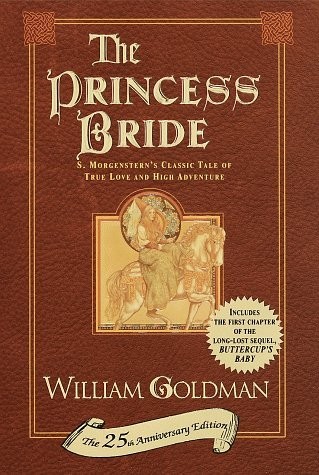
Talk to The Princess Bride like its author wrote you back.
Get the ideas that fit your life — not generic summaries.
- Chat with the book
- Audiobook-style main ideas
- Adapts to your life and goals
- Helps you take action
What it argues
The Princess Bride presents itself as an abridgment: William Goldman claims he is cutting the "boring parts" from a dense historical novel by the fictional S. Morgenstern, leaving only the good parts — adventure, romance, giants, swordsmen, pirates, and a villain so confident in his own intelligence that he talks his way into defeat. The framing device, in which Goldman describes reading the book as a sick child and now abridging it for his own son, is itself fiction; there is no Morgenstern original. The whole apparatus is a trick, and knowing it is a trick doesn't diminish it at all.
What Goldman is actually writing is a meditation on the stories we love when we're young and what happens to that love when we grow up and stop believing things work out. Westley and Buttercup are deliberately thin archetypes — beautiful, devoted, interchangeable — because the point isn't them. The point is Inigo Montoya, whose single-minded quest for vengeance turns out to be both absurd and genuinely moving. The point is Fezzik, the gentle giant who doesn't fit anywhere. The point is every time a character says "as you wish" and means something more complicated than the words.
What it gets right
- 1.
Goldman uses the fake-abridgment framing not as a gimmick but as a way of being honest about what popular storytelling actually does — it edits reality toward meaning.
- 2.
Inigo Montoya's arc works because it's absurd and earnest simultaneously — his twenty-year quest is both a joke and an actual psychological portrait of what obsession costs.
- 3.
The refusal of a clean happy ending is the book's most mature move; Goldman insists the world interrupts stories, and that's why stories matter in the first place.
What it covers
Who wrote it
William Goldman (1931–2018) was an American novelist and screenwriter, one of the most successful in both fields. He wrote the novels Marathon Man and Control as well as the screenplays for Butch Cassidy and the Sundance Kid, All the President's Men, and Misery, winning Academy Awards for the first two. He also wrote Adventures in the Screen Trade, his frank and often darkly funny account of Hollywood. The Princess Bride, published in 1973, was Goldman's love letter to the adventure stories of his youth; the 1987 film adaptation, which he also wrote, became one of the most quoted films in the English language.
