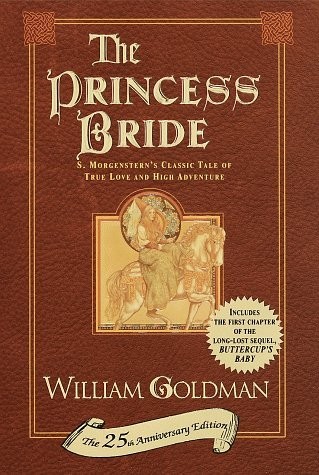
The Princess Bride by William Goldman is a 1973 fantasy book about true love and cynicism, storytelling and artifice, adventure as nostalgia. Goldman uses the fake-abridgment framing not as a gimmick but as a way of being honest about what popular storytelling actually does — it edits reality toward meaning.
Summary
The Princess Bride presents itself as an abridgment: William Goldman claims he is cutting the "boring parts" from a dense historical novel by the fictional S. Morgenstern, leaving only the good parts — adventure, romance, giants, swordsmen, pirates, and a villain so confident in his own intelligence that he talks his way into defeat. The framing device, in which Goldman describes reading the book as a sick child and now abridging it for his own son, is itself fiction; there is no Morgenstern original. The whole apparatus is a trick, and knowing it is a trick doesn't diminish it at all.
What Goldman is actually writing is a meditation on the stories we love when we're young and what happens to that love when we grow up and stop believing things work out. Westley and Buttercup are deliberately thin archetypes — beautiful, devoted, interchangeable — because the point isn't them. The point is Inigo Montoya, whose single-minded quest for vengeance turns out to be both absurd and genuinely moving. The point is Fezzik, the gentle giant who doesn't fit anywhere. The point is every time a character says "as you wish" and means something more complicated than the words.
Goldman's voice is the book's real engine. The interjections, the "abridger's" complaints about Morgenstern's digressions, the fake footnotes — these should feel like gimmicks, and somehow they don't. They make the romance more romantic by undercutting it at regular intervals; the sentiment earns its weight because it keeps being tested. The ending, which refuses to be unambiguously happy, is the best decision Goldman makes. He insists on the version his father told him, not the version he made up.
The book is funnier than it has any right to be, and sadder. It's also one of the more honest accounts of what good popular storytelling does: it takes you seriously enough to admit that the world doesn't always pay off the way the story does, and then gives you the story anyway. Readers who need their fantasy to be internally consistent and world-built to within an inch of its life will find this too silly. Readers who want to feel like a kid reading under the covers with a flashlight, but who also want the thing to be smart, are in the right place.
Talk to The Princess Bride like its author wrote you back.
Get the ideas that fit your life — not generic summaries.
- Chat with the book
- Audiobook-style main ideas
- Adapts to your life and goals
- Helps you take action
Key takeaways
- 1.
Goldman uses the fake-abridgment framing not as a gimmick but as a way of being honest about what popular storytelling actually does — it edits reality toward meaning.
- 2.
Inigo Montoya's arc works because it's absurd and earnest simultaneously — his twenty-year quest is both a joke and an actual psychological portrait of what obsession costs.
- 3.
The refusal of a clean happy ending is the book's most mature move; Goldman insists the world interrupts stories, and that's why stories matter in the first place.
- 4.
Every secondary character — Fezzik, the Dread Pirate Roberts, Vizzini — is more vivid than the leads, because Goldman is interested in types who exceed their type.
- 5.
The novel is a love letter to adventure fiction that simultaneously dismantles the genre's conventions, without that contradiction ever quite resolving into satire.
- 6.
"As you wish" works because it's an indirect declaration in a book full of people who can't say what they mean — and Goldman extends that indirection all the way to the ending.
- 7.
The humor consistently undercuts sentiment at the exact moment sentiment is about to become cloying, which is why the genuine emotional beats land harder than they should.
- 8.
Goldman's meta-commentary on the act of reading and retelling is more precise about what stories do to us than most literary fiction that tries to say the same thing.
Discussion questions
Use these on your own, with a book club, or as chat starters in Superbook. Book club version, ready to copy or print →
- 1.
Goldman's framing — sick child, father reading aloud, the abridger's nostalgia — is entirely made up. Does knowing that change how the device works emotionally?
- 2.
Westley and Buttercup are deliberately archetypal. Is that a flaw or a feature? What would be lost if Goldman had written them with more psychological depth?
- 3.
Inigo Montoya's quest is played for laughs and for pathos simultaneously. Is that tonal doubleness earned, or does it let the book off the hook emotionally?
- 4.
The ending refuses to resolve cleanly. Goldman says it's the real ending, the one his father told him. What do you think he's actually saying about stories and disappointment?
- 5.
Vizzini is defeated by his own certainty in his superior reasoning. It's a comedy bit, but Goldman seems serious about the type. Where do you see that character in real life?
- 6.
The 1987 film is extremely faithful to the novel while also being very different in tone — warmer, more safely comic. Which is the better object, and what does the difference reveal about each medium?
- 7.
Goldman interrupts the story with commentary from the abridger constantly. At any point did the interruptions genuinely bother you, or did they always feel like part of the contract?
- 8.
The book is set in a fictional medieval Europe with no clear allegory, but Goldman occasionally pokes through with contemporary observations. Does that date the book or give it staying power?
- 9.
Fezzik is the warmest character in the book and gets the least page time. Why do you think Goldman kept him secondary?
- 10.
The Princess Bride is often described as a book people love intensely and forever because they read it at age twelve. Do you think it works as well if you first encounter it as an adult?
- 11.
Goldman says he only kept 'the good parts.' What does he seem to think the good parts of a story are?
- 12.
The novel treats true love as both the most important thing in the world and a kind of absurdity. Does it resolve that tension, or leave it deliberately open?
Themes
Frequently asked questions
-
Is The Princess Bride the book or the movie better?
They are excellent in different ways. The movie is tighter and warmer; Goldman's own screenplay streamlines the meta-fiction considerably. The novel is funnier and darker, and the fake-abridgment framing does things the film can't replicate. Reading the book first makes the movie richer; watching the movie first makes the book feel like a commentary on it.
-
Is there really an original S. Morgenstern novel?
No. S. Morgenstern is a fictional author Goldman invented. There is no longer original. The entire framing device — including Goldman's claims about his own childhood and his invented son — is fiction within fiction. Knowing this ruins nothing.
-
Who shouldn't read The Princess Bride?
Readers who dislike narrative intrusion, meta-fiction, or comedy that interrupts sentiment at critical moments. If you want your fairy tale straight, uninterrupted, and earnest throughout, this will irritate you.
-
What is The Princess Bride actually about?
On the surface it's a swashbuckling adventure with a romance at its center. Underneath, it's about why we love the stories we love — and what we do when the world fails to live up to them.
-
Is The Princess Bride hard to read?
No. It's fast, compulsively readable, and designed to be enjoyed by almost anyone who liked adventure stories as a child. The meta-fictional elements aren't demanding — they're part of the fun.